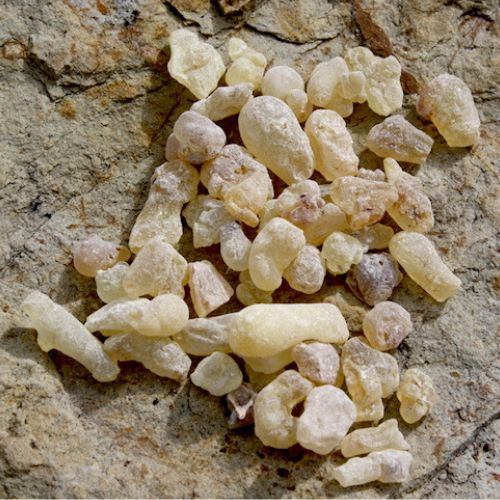
BOSWELLIA for Horses (Wild Crafted Tincture)
Boswellia ( Boswellia serrata ) is a traditional tree resin used to support everyday mobility and the body's normal inflammatory response in horses who may take a little longer to get going.
Some horses aren't obviously lame - they might just come out of the stable a bit like me getting out of a deckchair, and need a good stretch in all directions before everything remembers how it works.
This is where Boswellia earns its place. Also known as Indian frankincense, its resin has a long tradition of use for movement and flexibility. We offer it as an easy-to-feed tincture, either on its own or as part of a wider mobility plan.
At a glance:
- Wild-harvested, human-grade tincture, laboratory tested for identity against British and European Pharmacopoeia standards.
- Feed 6ml/100kg bodyweight daily in feed, i.e. 30ml for a 500kg horse.
- NB. Check with your vet before feeding alongside prescribed pain relief or blood-thinning medication, or to pregnant or nursing mares.
*This is a nutritional, functional food supplement and not veterinary medicine. For more information, refer to Dr Kellon's Horse Sense - Nutrition is not 'Alternative' Therapy .
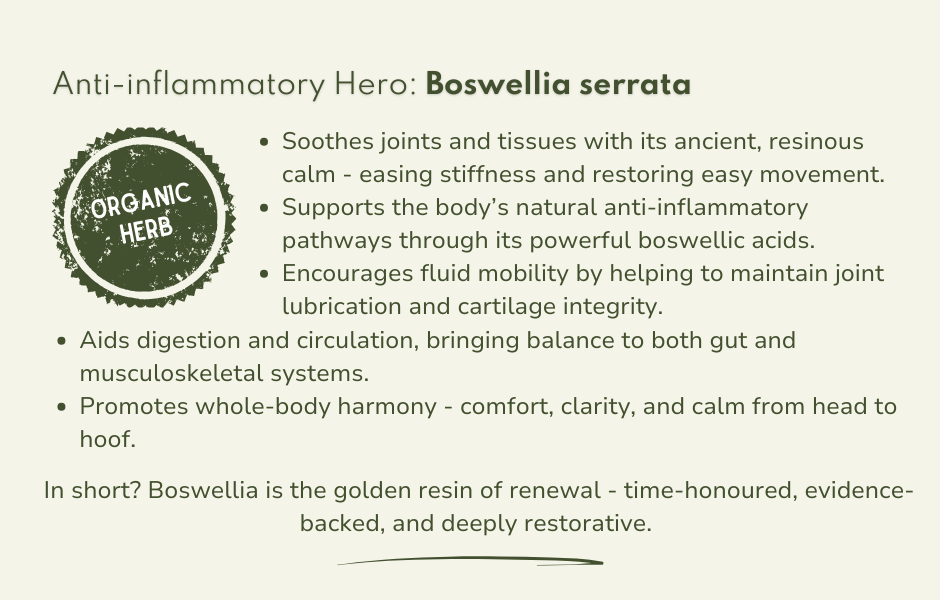
Boswellia and the EquiNatural mobility range
There are several ways to support a horse’s movement, and they don’t all do the same job.
- Glucosamine is a nutrient used in building the structures of the joint.
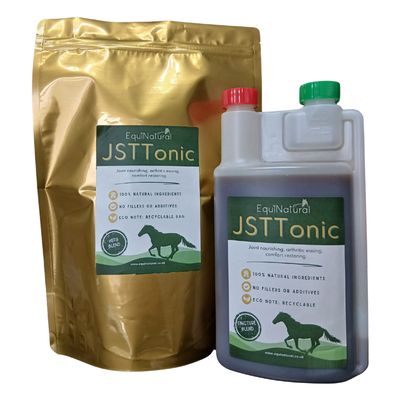
- JSTTonic blends several botanicals together for broader joint and connective-tissue support.
- Boswellia is the individual resin for when everyday movement comfort is the main priority and you'd like to keep things simple.
Its character comes from naturally occurring compounds called boswellic acids. These have attracted plenty of scientific interest for their relationship with inflammatory signalling – one of the normal processes involved when tissues respond to work, strain and daily wear.
For the horse whose general movement could use ongoing botanical support, Boswellia is very useful to keep on the shelf.
Boswellia feed guide & dosage
💧Organic boswellia tincture
Our human-grade tinctures capture the plant's naturally occurring constituents in a concentrated, easy-to-feed liquid form.
- Boswellia serrata, Resin
- Cold Macerated 1:3 90%
- Wild Harvested
- Feed Guide - 6ml/100kg bodyweight, daily in feed.
Naturally occurring plant constituents
Includes: boswellic acids, among them beta-boswellic acid, 11-keto-beta-boswellic acid (KBA) and acetyl-11-keto-beta-boswellic acid (AKBA), alongside other naturally occurring resin compounds.
Footnotes
- Laboratory tested for identification and compliance to the British and European Pharmacopoeia standards.
- Human grade.
- ♻️ Eco Note: Our packaging is recyclable and refillable.
How Boswellia works in horses
If you'd like the science, 'energetic architecture' explains how a herb is designed to work within the body – not just what's in it, but the particular tissues and functions it has an affinity with.
Boswellia has a particular affinity with movement comfort and the body's normal inflammatory response. Its role is to support how the horse moves and feels as the tissues meet the demands of everyday life.
- Supporting normal inflammatory balance. Boswellic acids have been studied for the way they interact with inflammatory signalling. We use Boswellia to support the body's normal ability to respond and then settle, not to switch that response off. Inflammation is part of the repair crew, after all; it just shouldn't move in permanently.
- Maintaining comfortable movement. Boswellia is traditionally valued where movement has become less free over time: the horse who needs longer to warm up, or seems a bit less supple through ordinary work.
- Fitting into a wider mobility plan. As a single herb, Boswellia can be fed where joints, connective tissue and overall condition all need attention.
The big picture
Boswellia offers botanical support for comfortable, everyday movement. It does a different job from structural nutrients and broader mobility blends, which makes it useful when you know what you want to add, and why.
Boswellia safety
Boswellia is generally well tolerated at the recommended feeding rate, but take care in the following situations:
- Prescribed pain relief or anti-inflammatory medication: check with your vet before combining. Don't alter prescribed doses or alternate medication and Boswellia without veterinary advice.
- Medication affecting blood clotting: seek veterinary guidance before feeding.
- Pregnant or nursing mares: avoid unless professionally advised, as safety information for concentrated preparations is limited.
Boswellia in history & tradition
Frankincense has travelled a long way to reach the feed room.
For centuries, its resin was collected from trees growing in dry, difficult landscapes, where small cuts in the bark allowed it to seep out and harden into the little pieces known as tears. Those tears were carried along trade routes, burned as incense and valued in traditional herbal practice.
There’s an important botanical distinction here, though: frankincense isn’t one single species. Our tincture is made from Boswellia serrata , the Indian frankincense tree, known in India as salai.
In Ayurvedic tradition, Boswellia serrata resin became particularly associated with movement and flexibility. That traditional interest is one reason modern researchers began looking more closely at its boswellic acids and how they interact with inflammatory pathways.
The research is interesting, but it needs reading in context. Some studies have used standardised extracts rather than a whole-resin tincture, and a small equine study used Boswellia alongside two other herbs rather than testing it alone. That leaves plenty still to learn about individual preparations in horses.
For me, the lasting appeal is more straightforward: this is a resin with a long-standing, recognisable role. When movement comfort is the question, Boswellia is one of the individual botanicals worth knowing about. Ned, I'm sure, would just be relieved it goes in the feedbowl and not up in smoke.
Boswellia FAQs
Q - How do I know whether Boswellia is the right herb for my horse?
We’d look at Boswellia when ongoing movement comfort is the main priority – i.e. if your horse takes longer to loosen up, feels less free through ordinary work, or needs a little more mobility support as they get older.
If the change is sudden, pronounced or worsening, that's a conversation for your vet.
Q - What’s the difference between Boswellia and Glucosamine?
They have different roles. Glucosamine is a nutrient associated with the structures of the joint; boswellia is a botanical resin valued for supporting comfortable movement and normal inflammatory balance.
They work well together in a considered mobility plan.
Q - Should I choose Boswellia or JSTTonic?
Choose Boswellia if you want a single herb with a focused role in movement comfort. JSTTonic is the broader blend when you’re looking for support across joints and connective tissues, i.e. onset arthritis.
Q - How long should I feed Boswellia?
Boswellia is generally used consistently as part of an everyday support routine.
Give yourself a reasonable period to observe how your horse moves and feels, while keeping their workload, footing and other management as consistent as possible. There isn’t a reliable, established response time for this particular tincture in horses.
Q - Is Boswellia tincture the same as frankincense essential oil?
No. Our product is a tincture produced from Boswellia serrata resin. Essential oil is a different preparation containing mainly volatile aromatic compounds, and is useful for topical application.
Make sure you don't substitute the essential oil for the tincture in your horse’s feed.
© EquiNatural 2026. Written by Carol Moreton, Founder, EquiNatural. All content is original work protected under copyright, and may not be re-published, duplicated, or rewritten for commercial use without permission.