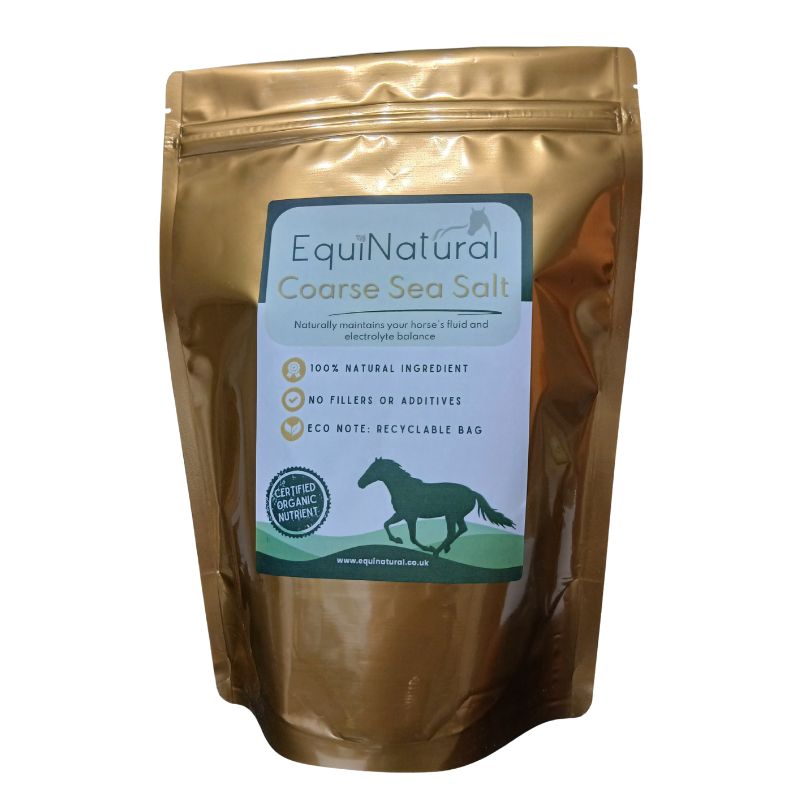
SEA SALT for Horses | Daily Sodium, Chloride & Hydration Support (Soil Association Certified)
Does your horse have salt in the feed bowl every day, or just a lick available when they fancy it?
That little question matters more than it sounds. Salt supplies sodium and chloride, two essential electrolytes your horse needs for normal fluid balance, nerve signalling and muscle function. They’re also lost in sweat.
Our Soil Association certified sea salt is a simple way to add a measured daily amount to the feed bowl. Think of it as an everyday nutritional foundation, with the amount reviewed when work, heat or sweating increases.
NB. We also include a daily 10g salt ration in our VitaComplete
mineral balancer.
*Please note this is a nutritional, functional horse food supplement and not veterinary medicine. See Dr Kellon’s Horse Sense – Nutrition is not ‘Alternative’ Therapy
.
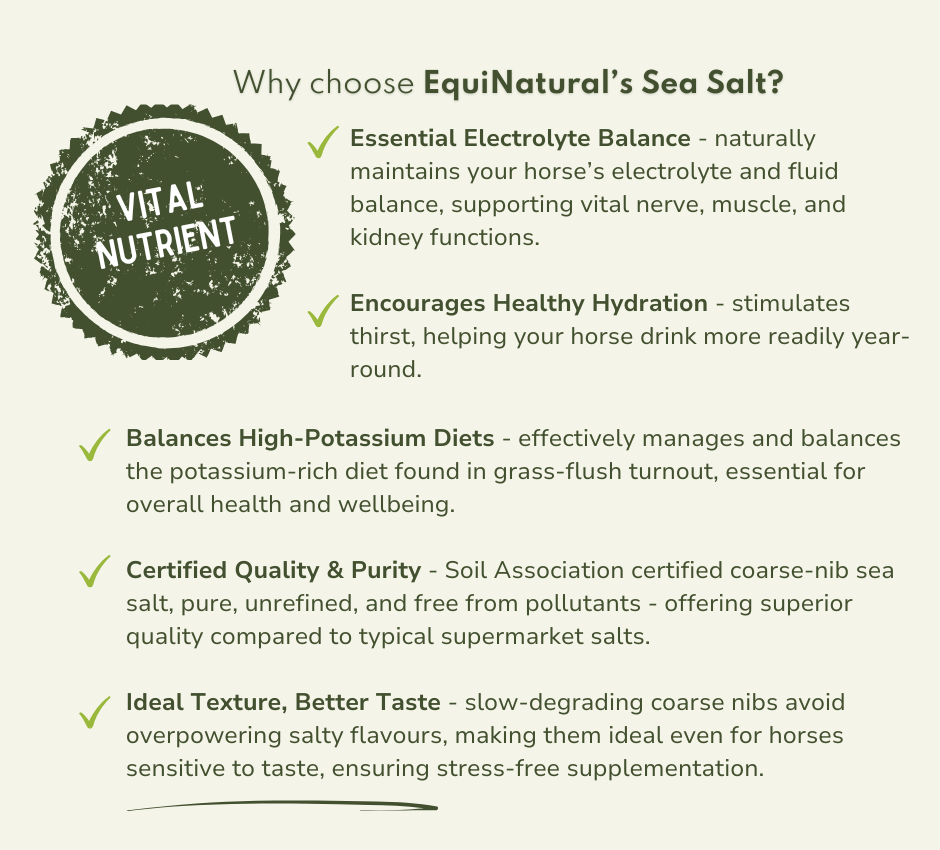
Overview
Salt is easy to overlook because it’s so ordinary. Yet sodium and chloride are part of the everyday workings of a horse’s body: helping maintain fluid balance and supporting normal nerve and muscle function.
Forage generally supplies little sodium, while sweat carries away both sodium and chloride. That makes a measured serving of loose salt useful even for horses doing very little, and especially worth reviewing when the weather warms up or work increases. Salt also helps stimulate normal thirst, so it belongs in the winter conversation as well as the summer one.
We keep salt separate from EquiVita because it attracts moisture. Adding it to a mineral blend could affect how the blend stores and handles. The simple answer? Feed your minerals, then add the salt separately.
Is salt right for your horse?
✔ You’d like a measured daily source of sodium and chloride
✔ Your horse relies on forage and may get little added salt elsewhere
✔ You want to account for extra sweat losses during work or warm weather
✔ You’d prefer to add loose salt to feed rather than rely entirely on a lick
In short: salt is one of the simplest parts of a horse’s daily feeding plan. The useful question is how much your horse is already getting from feed and electrolyte products.
Layering support
- Electrolyte-PLUS – for more substantial sweat losses, i.e. hot weather or hard work, where a broader electrolyte plan may be needed. Check how much sodium chloride the product already supplies before adding a full serving of salt as well.
The foundations
Salt supplies sodium and chloride; it doesn’t replace a balanced diet. Forage, appropriate protein and a mineral balancer such as EquiVita or VitaComplete still have their own jobs to do.
*If you’re not already feeding a mineral balancer, try one of our 1kg trial bags.
Composition & feed guide
🌿Soil Assocation Certified Sea Salt (Fine)
Composition
100% pure, unrefined fine sea salt from the Red Sea, certified under the Soil Association approved product scheme.
Naturally harvested and dried; non-irradiated and non-bleached. See our Quality page for certification documents.
Feed guide
- 4g per 100kg bodyweight — 20g for a 500kg horse.
- Introduce gradually if your horse isn’t used to salt in the feed. Horses in hard work or sweating heavily may need more; use their workload, conditions and the salt already supplied by other feeds or electrolytes to guide the total.
Footnotes
- Laboratory tested for identification and compliance to the British and European Pharmacopoeia standards.
- Human grade.
- Please be aware that if you're purchasing our dried botanicals for human use, our dried range is cut to appropriate sizes for feeding to horses.
- ♻️ Eco Note: Our packaging is recyclable and refillable.
Functional nutritional value
Soil Association certified sea salt from the Red Sea primarily provides essential electrolytes such as sodium and chloride for fluid balance and nerve/muscle function, along with trace minerals - potassium, calcium, magnesium, and natural iron - due to its minimal processing.
The science behind salt
Salt isn’t glamorous. It’s simply one of those small, essential things that helps the rest of the horse get on with being a horse - provided there’s always plenty of clean water available too.
- Supporting fluid balance – Sodium and chloride help the body manage the movement and distribution of water.
- Supporting nerve and muscle function – Electrolytes are involved in the electrical signals that allow nerves and muscles to do their everyday work.
- Replacing everyday losses – Horses lose sodium and chloride in sweat. Those losses can rise considerably with exercise and heat, which is why a hard-working horse may need a feeding plan beyond its usual daily salt.
Clinical considerations
Advisories
- Ensure fresh water is always available, as salt increases thirst and supports normal hydration behaviour.
Contraindications
There are no major contraindications for salt when used at normal physiological levels, but:
- Use caution in horses with acute renal impairment, uncontrolled heart disease, or severe oedema, and seek veterinary guidance.
- Avoid over-supplementing if feeding fortified electrolytes; balance matters.
Salt FAQs
Isn’t a salt lick enough?
Salt blocks are designed for cattle, yet they've mysteriously found their way into the horse world.
And yes, some horses will use a lick regularly, where other will barely touch it. If you want to know how much salt is going into your horse each day, adding a measured amount to the feed bowl makes that easier.
Does my horse need salt in winter?
Yes. Sodium and chloride remain daily nutrients when the temperature drops. It also has an extra benefit in winter as it encourages hydration - winter being a typical time when a horse doesn't drink as much water, and particularly when your horse is eating more dry hay.
Can I feed sea salt alongside EquiVita or VitaComplete?
Yes. We deliberately keep salt separate from EquiVita because salt attracts moisture, but we include a daily 10g ration in VitaComplete for the convenience aspect. Add each to the feed according to its own guide.
Is sea salt enough for a horse that sweats heavily?
It can form part of the plan, but heavy sweating increases electrolyte losses. Look at the horse’s work, weather conditions, water intake and any electrolyte product already being fed.
Does sea salt provide useful amounts of other minerals?
The reason to feed it is sodium and chloride. Sea salt may contain traces of other minerals, but those traces shouldn’t be counted on to balance the wider diet.
© EquiNatural 2026. Written by Carol Moreton, Founder, EquiNatural.
All content is original work protected under copyright, and may not be re-published, duplicated, or rewritten for commercial use without permission.