

THYME for horses (Thymus vulgaris) | Gut Microbiome & Digestive Support
When the gut needs the protective power of an aromatic herb
Thyme is one of our traditional ‘oily herbs’, valued for helping maintain a healthy intestinal environment and supporting the natural balance of the gut microbiome.
Its aromatic compounds - particularly thymol and carvacrol - help make conditions less welcoming to unwanted organisms, while its warming, carminative character supports comfortable digestion and normal clearance.
Feed Thyme individually when that protective digestive action is the priority, or find it working alongside other aromatic herbs in BiomeTonic and VermClear.
Tiny leaves, maybe, but a big say on who gets to settle in.
*Please note this is a nutritional, functional horse food supplement and not veterinary medicine. See Dr Kellon's Horse Sense - Nutrition is not 'Alternative' Therapy .
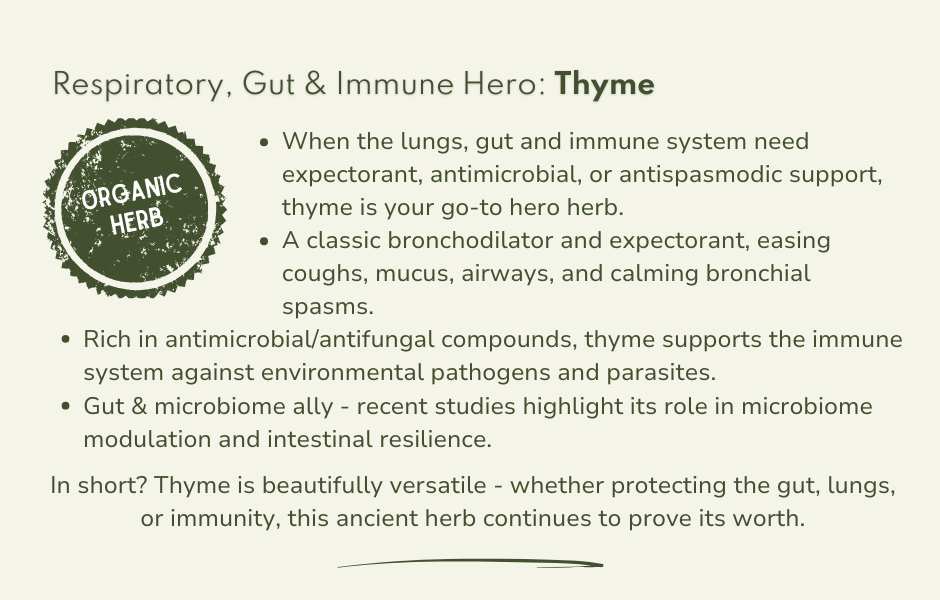
Find Thyme in the EquiNatural range
You'll find Thyme in BiomeTonic , where its aromatic oils sit alongside Rosemary, Sage, Oregano and other herbs supporting the wider intestinal environment and microbial balance.
It's also part of VermClear , contributing its traditional digestive and protective character to our short-course parasite-support formula.
Feed guide
💧Organic Thyme Herb Tincture
Our human-grade, certified organic tinctures capture the plant's naturally occurring constituents in a concentrated, easy-to-feed liquid form.
- Thymus vulgaris (Thyme), Leaf
- Cold Macerated 1:3 35%
- Organic Cultivated
- Feed Guide - 6ml/100kg bodyweight, daily in feed.
🌿Organic Dried Thyme Herb
Grown, harvested and dried without the use of agri-chemicals, non-irradiated and GMO free - see our Quality page for Quality Management & Certification Documents.
- Thymus vulgaris (Thyme), Leaf
- Organic Cultivated
- Origin Morocco
- Feed Guide - 5g/100kg bodyweight per day, i.e. 25g for a 500kg horse.
Footnotes
- Laboratory tested for identification and compliance to the British and European Pharmacopoeia standards.
- Human grade.
- Please be aware that if you're purchasing our dried botanicals for human use, our dried range is cut to appropriate sizes for feeding to horses.
- ♻️ Eco Note: Our packaging is recyclable and refillable.
- 🧊 Storage Tip: Keep cool and dry.
Naturally occurring plant constituents
Volatile oils (thymol, carvacrol), tannins, flavonoids (apigenin, luteolin, thymonin, naringenin), labiatic acid, caffeic acid, saponins, resins.
Energetics - how Thyme works
If you want the science, 'energetic architecture' explains how a herb is designed to work within the body – not just what's in it, but the particular tissues and functions it has an affinity with.
Thyme is a warming, aromatic herb with a strong affinity for the digestive environment, helping to maintain conditions in which the right microbial community can hold its ground.
- Applying protective microbial pressure - Thymol and carvacrol have been widely studied for their antimicrobial activity and effects on microbial cell membranes. That research helps explain Thyme's long traditional use as a protective aromatic herb.In the whole-horse nutritional context, we're interested in something gentler: supporting a healthy intestinal environment and normal microbial balance, rather than treating the microbiome as something to be wiped clean.
- Keeping digestion moving - Thyme’s warming, carminative oils traditionally support normal digestive secretions, comfortable movement and the onward passage of gas and intestinal contents. This matters because natural clearance depends upon a gut that keeps doing its job.
- Looking after the terrain - Flavonoids and phenolic acids provide antioxidant support for the intestinal tissues, helping protect the environment in which digestion and microbial fermentation take place.
Big picture
Thyme applies aromatic pressure, supports movement and looks after the terrain underneath.
Protect the terrain, keep things moving, let the microbial community get on with its job.
Clinical considerations
- Thyme is generally considered well tolerated at normal feeding levels.
- We don't recommend feeding it during pregnancy or nursing unless advised by your vet.
Thyme in history & tradition
Thyme in history & tradition
Thyme has been keeping us company for a very long time. Long before it became a familiar kitchen herb, those tiny aromatic leaves had earned themselves quite a reputation for courage, protection and practical usefulness.
The ancient Greeks burned thyme as incense in religious ceremonies, while the Romans associated it with courage and vitality. Quite a responsibility for a little herb growing quietly on a sunny hillside.
That brave reputation followed thyme into medieval folklore, where sprigs were said to be embroidered onto gifts for knights heading off to battle. Whether it helped anyone feel braver is another matter, but the sentiment was rather lovely: a little herbal “look after yourself” stitched into the fabric.
Away from the grand stories, thyme still had an everyday place in the kitchen. Across Europe, North Africa and western Asia, its fragrant leaves found their way into countless dishes. It’s easy to imagine why it stayed: easy to recognise, full of flavour, and useful enough to keep close to hand.
The old herbalists gave it plenty of attention too. Written accounts of its medicinal use reach back to the first century AD, and respiratory complaints became a familiar part of its traditional story. Thyme’s history stretches well beyond the digestive role we give it here at EquiNatural.
A herb for the cooking pot, a place in the household herb cupboard, and a little courage tucked into its folklore.
Not bad for a plant you can step over without noticing - until you catch that scent.
Thyme's FAQs
How do I know if Thyme is the right herb for my horse?
We'd look at Thyme when you want simple aromatic support for the gut environment and microbial balance.
Its naturally occurring volatile oils give it that strong protective character, while its traditional carminative action supports comfortable digestion and normal movement through the gut.
So if the priority is helping maintain a healthy intestinal neighbourhood – without bringing in a whole formula – Thyme is a lovely individual herb to consider.
If Thyme is antimicrobial, won't it harm the good gut bacteria too?
A healthy gut isn't meant to be sterile – and we're certainly not trying to make it one.
Thyme's aromatic compounds, particularly thymol and carvacrol, have been widely studied for their effects on microbes. But feeding the whole herb nutritionally isn't the same thing as trying to disinfect the horse's hindgut.
Our interest is in supporting an intestinal environment where the normal microbial community can hold its ground.
Think microbial balance, not microbial wipe-out.
What's the difference between Thyme and BiomeTonic?
Thyme is the individual herb we'd choose when its particular aromatic, protective digestive action is what we're after.
BiomeTonic brings Thyme together with other oily herbs including Rosemary, Sage and Oregano for broader, long-term support of the hindgut microbial environment.
So if one herb fits the job, keep it simple.
If you're looking for proactive microbiome maintenance, particularly after SiboCARE or another gut reset, that's where BiomeTonic earns its place – often alongside WildFed to bring ongoing botanical diversity into the diet.
Thyme looks after its corner of the neighbourhood. BiomeTonic brings the neighbourhood watch.
Why is Thyme included in VermClear?
Because parasites don't exist separately from the gut environment they live in.
Thyme brings its aromatic oils, traditional digestive action and microbial-supporting character to VermClear, where it works alongside the other herbs as part of a short-course formula supporting the intestinal environment and natural clearance.
It simply reflects a very EquiNatural ethos: don't only think about the unwanted guests; think about the neighbourhood they're trying to live in.
Should I choose dried Thyme or the tincture?
Either – choose whichever suits your horse and your feed routine.
The dried herb gives you the whole cut-and-dried leaf, while the tincture provides Thyme's naturally occurring constituents in a concentrated liquid form and can be useful where smaller feeding volumes are preferred.
Same Thyme. Different presentation.
And given its unmistakable aroma, Ned is unlikely to need us to point out that something new has arrived in dinner. 😉
© EquiNatural 2026. All content is original work protected under copyright, and may not be re-published, duplicated, or rewritten for commercial use without permission.
