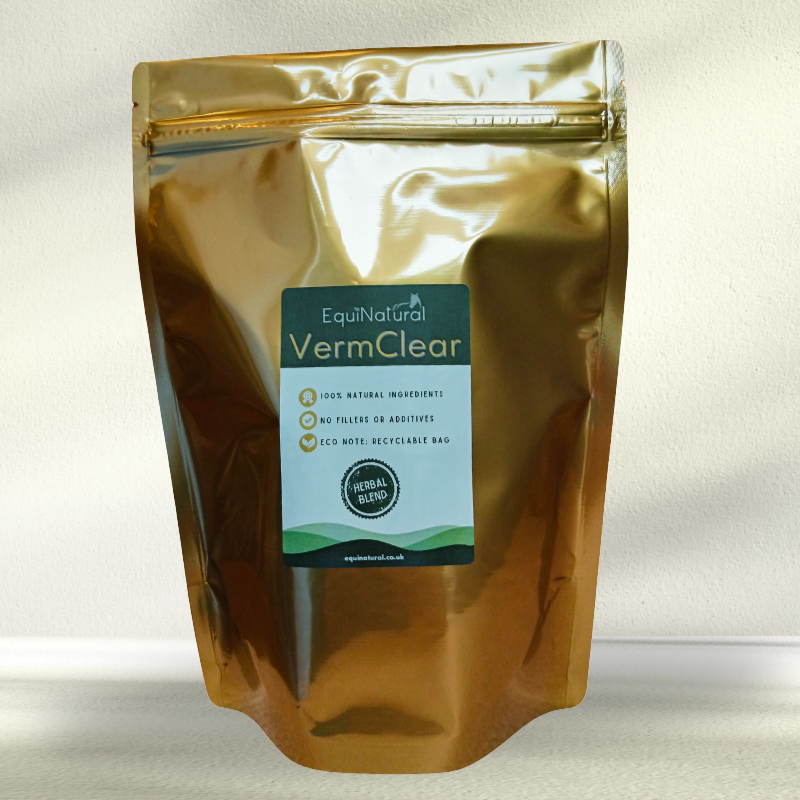
VERMCLEAR for Horses | Natural Herbal Parasite & Gut Support 🍂NOVEMBER SALE - 20%-OFF

Looking for natural support for your horse around worm-testing season?
You might have just done a worm count, you're reviewing your horse's parasite programme, or you're simply looking for something to support the gut alongside pasture management and strategic worming when it's needed.
That's where we'd look at VermClear.
“Really good product and horses had no issues eating it, even the fussy one!” Charlotte W.
Our short-course herbal blend combines bitter, aromatic and fibre-rich plants traditionally used to support healthy digestion, intestinal movement and natural parasite elimination – while helping maintain a gut environment that's a little less welcoming to unwanted guests.
*S ee our two blogs - Verms & Waiting for the hard frost: natures helping hand against equine parasites

Overview - why do some horses carry more worms than others?
Put several horses on the same pasture, exposed to the same weather and grazing the same fields, and something interesting can happen.
One repeatedly comes back with a higher worm egg count, while another barely registers.
Why?
Parasite exposure matters, of course - but so does the horse they're trying to live in. The intestinal tract is a busy ecosystem, shaped by digestive function, microbial communities, gut movement and the horse's own natural defences.
And that's where VermClear comes in.
Looking after the gut as well as counting the worms
VermClear brings together bitter, aromatic and fibre-rich herbs with deliberately different jobs.
Some support normal digestive secretions and intestinal movement, while others support natural parasite elimination, microbial balance, and the gut lining itself. So rather than focusing only on the unwanted guests, VermClear helps support the intestinal environment they're trying to live in too.
That doesn't replace faecal worm egg counts, pasture management or strategic veterinary worming when it's needed - it simply gives us another part of the picture.
Count the worms, manage the pasture, treat when necessary - and don't forget to look after the horse carrying them.
How VermClear fits into your horse's support plan
VermClear is a good fit when you're looking to work alongside a test-led parasite programme.
Choose VermClear if your horse:
✔ Grazes shared pasture where parasite exposure is naturally part of life
✔ Has regular faecal worm egg counts and you'd like to support the gut alongside monitoring
✔ Is one of those horses who repeatedly carries a higher worm burden than their fieldmates despite sharing the same pasture and management
Supporting the wider picture
Once the five-day course is finished, there's no automatic need to move onto another product, but where the horse gives us a reason to look further:
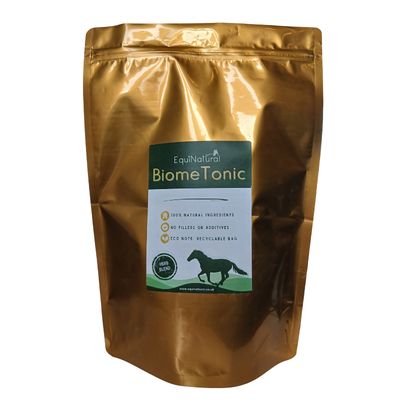
- BiomeTonic – for longer-term support for hindgut microbial balance, particularly in horses whose gut ecology needs ongoing attention.
- SiboCARE – where gas, bloating, or hindgut instability suggest there's a wider hindgut imbalance.
- And where the diet itself lacks plant and fibre diversity, WildFed can help broaden what reaches the hindgut over the longer term.
Foundation support
Good parasite management starts with the whole horse, so supporting your horse's baseline nutrition with a forage-balanced mineral solution such as EquiVita or VitaComplete helps provide the nutritional foundations your horse relies upon every day.
*If you're not already feeding a mineral balancer, try one of our 1kg trial bags to start with.
In summary
Use VermClear as a short-course alongside a test-led parasite programme. Count the worms, manage the pasture, treat when necessary, and support the gut.
Composition & feed guide
*VermClear is a nutritional, functional food supplement and not veterinary medicine. For more on this, see Dr Kellon's article - Nutrition is not 'Alternative' Therapy .
What's in VermClear?
The herbs used in VermClear have a long history of use around intestinal parasites, with modern research also exploring the antiparasitic activity of some of their naturally occurring compounds - which explains why these particular plants earned their place in the formula.
Organic herbs: Wormwood ( Artemisia absinthium ), Sage ( Salvia officinalis ), Thyme ( Thymus vulgaris ), Ginger ( Zingiber officinale ), Fennel ( Foeniculum vulgare ), Turmeric ( Curcuma longa ), Cayenne ( Capsicum annuum ), Psyllium ( Plantago ovata ) and Elecampane ( Inula helenium ). Some earned their reputation because herbalists have used them around parasites; others support the digestion, intestinal movement, fibre and gut comfort that matter to the environment those parasites are trying to inhabit..
Feed guide
🌿Dried herbal blend, ground
Human grade, produced to ecological standards and free from agro-chemicals. See our Quality page for Organic Certification Documents.
- Feed 4g/100kg bodyweight daily in feed for 5-days.
Fussy eater?
Horses sometimes have their own opinions (and strong tastebuds!), so introduce gradually, building up over several days. See our Fussy Eaters guide for helpful tips if needed.
♻️ Eco Note: Our packaging is recyclable and refillable.
Energetics - how VermClear works
If you want the science, 'energetic architecture' explains how a blend is designed to work across the body's interconnected systems – not just which herbs are included, but how they interact to create a specific effect.
VermClear is built around one idea - when you're thinking about worms/parasites, it's worth thinking about the gut they're trying to live in too.
Which means... VermClear's formula combines bitter and aromatic plants with digestive herbs and soluble fibre to support the intestinal environment from several directions.
How the formula works
- Making the gut a less friendly neighbourhood - Wormwood, Sage and Thyme bring the strongly bitter and aromatic character of the blend, traditionally used around parasite management while also supporting normal digestive activity and microbial balance.
- Keeping things moving - Ginger, Fennel and Cayenne support digestive secretions and normal intestinal movement, while Psyllium provides soluble fibre and supports regular elimination. Whatever's happening inside the gut, we'd quite like the traffic to keep moving in the right direction!
- Looking after the gut along the way - VermClear isn't only interested in making life awkward for unwanted guests. Psyllium and Elecampane, alongside the wider formula, bring soothing digestive support too – helping maintain the intestinal environment and gut comfort throughout the short course.
Big picture
VermClear's job is to support the horse's side of the equation – healthy digestion, normal intestinal movement and a well-functioning gut environment. It isn't designed to replace testing, pasture management and strategic worming when it's genuinely needed.
Count the worms, manage the pasture, treat when necessary. And make sure the unwanted guests aren't getting five-star accommodation in between.
New to herbal parasite support? Let the testing guide you
If you've never used herbal support around parasite season before, you don't have to guess what's happening.
A simple faecal worm egg count (FEC) - ideally evaluated via the Westgate Labs Threshold Guidelines - gives you something objective to work from and a useful baseline.
Thereafter, a structured testing timeline can help you see how your horse's own egg-shedding pattern changes over time.
1. Start with a worm egg count
Carry out an FEC from your kit before starting VermClear. This gives you a useful baseline and importantly, tells you whether your horse needs veterinary worming rather than nutritional support alone.
2. Feed VermClear for the recommended 5-day course
Then continue with your normal test-led parasite programme.
3. Keep monitoring
Over time, you'll build a useful picture of your horse's own pattern – whether they tend to remain a low shedder or generally return higher counts and need a different management approach.
- The 14-day post-blen d check : Carry out a follow-up FEC 14 days after completing the 5-day course and compare the EPG with your starting count.
- The 6–8 week check : Test again 6–8 weeks later to see whether the count remains similar or egg shedding has risen again.
4. Let the result make the decision
If testing shows that worming treatment is needed, treat appropriately. VermClear isn't there to overrule the test result or replace an effective wormer when one is required.
And remember, standard FECs don't detect every equine parasite or every stage of infection, so other testing or veterinary advice may sometimes be needed.
The simple rule?
Don't guess whether your parasite programme is working. Test, monitor, and let your horse's own results guide what happens next.
Top tips
- Don't chase a particular number just to avoid worming. Use your laboratory's current treatment thresholds and your horse's wider parasite risk to decide whether treatment is needed.
- While FECs are excellent for tracking strongyles and ascarids, they won't give you a complete picture:
> Pinworm eggs are rarely detected on standard FECs because they're deposited around the anus rather than passed routinely in the droppings. Tail-rubbing can be a clue, but isn't diagnostic on its own - you're probably better off with an adhesive-tape test.
> Encysted Cyathostomes : Standard FECs only detect egg-laying adults, so encysted larval stages can remain invisible on a poo test. Your vet or parasite-testing provider can advise on appropriate seasonal risk assessment and additional testing where needed.
Clinical considerations / veterinary reference
Advisories
- VermClear is designed to sit alongside a test-led parasite-management programme and should not replace appropriate parasite testing, pasture management or veterinary worming when treatment is indicated.
- Introduce gradually, particularly for horses with sensitive digestion.
- If testing indicates a significant parasite burden, seek appropriate veterinary or suitably qualified parasite-management advice.
Contraindications
- Not recommended for pregnant/nursing mares as safety has not been established.
- Not recommended for horses with diagnosed gastric ulceration, inflammatory intestinal disease or significant digestive sensitivity.
- I f your horse is receiving prescribed medication, particularly anticoagulant, corticosteroid or other long-term treatment, check with your vet before introducing VermClear.
- Competition horses - c heck the current prohibited-substance rules applying to your discipline before use.
Vet reference
A concise, vet-friendly reference is available for sharing with your vet.
VermClear FAQs
Is VermClear a natural wormer – and can it replace conventional worming?
Not quite - and we think that distinction matters. VermClear is designed to sit alongside a test-led parasite programme, rather than replace veterinary worming when it's needed.
Its bitter, aromatic and fibre-rich herbs support intestinal movement and natural parasite elimination, while helping maintain a gut environment that's a little less welcoming to unwanted guests.
So our approach is simple - count the worms, manage the pasture, treat when necessary – and support the horse carrying them.
When should I feed VermClear?
We'd ideally start with a faecal worm egg count, so you know what's actually going on rather than worming – naturally or otherwise – on guesswork.
VermClear is then fed as a five-day course alongside that wider parasite-management programme.
Remember that standard worm counts don't detect everything – tapeworm, pinworm and encysted small redworm need different approaches – so your testing and treatment plan needs to take those into account too.
Because one poo sample, useful though it is, doesn't possess a crystal ball. 😉
My horse always has higher worm counts than the others – could VermClear help?
This is exactly where we'd be interested in looking beyond the worms themselves. Two horses can share the same field and management yet repeatedly produce very different worm counts.
Exposure matters, but so does the gut they're trying to live in – its digestive function, microbial community, intestinal movement and the horse's wider natural defences. VermClear supports that side of the equation.
It doesn't guarantee a lower worm count, so keep testing. But if your horse is the one who repeatedly comes back higher than their fieldmates, we'd certainly be interested in supporting the gut as part of the wider plan.
Can I feed VermClear after my horse has been wormed?
Yes – but there's no automatic need to.
If testing shows your horse needs veterinary worming, that treatment has a specific job to do. Once treatment is complete, you can consider VermClear as part of the wider gut-support picture if there's a reason to.
The important thing is that strategic worming deals with the parasite burden; VermClear supports the horse and intestinal environment.
Do I need to follow VermClear with BiomeTonic?
Not necessarily - once the five-day course is finished, there's no compulsory next product.
If your horse is doing beautifully, their gut seems settled and there's nothing else waving at you, we're perfectly happy to leave well alone, unless:
- BiomeTonic may be useful where longer-term hindgut microbial balance needs support, or...
- SiboCARE where gas, bloating or recurring digestive instability suggests a wider hindgut issue, or...
- WildFed where you'd simply like to increase plant and fibre diversity.
Follow the horse, not a supplement conveyor belt.
Can every horse have VermClear?
Not quite – there are a few occasions when we'd check first.
It's not recommended for pregnant or nursing mares, as safety of the complete multi-herb formula hasn't been established during pregnancy or lactation.
For horses with gastric ulcers, inflammatory intestinal disease or significant digestive sensitivity, we'd check with your vet first, as VermClear contains strongly aromatic, bitter and warming herbs.
Likewise, if your horse is taking prescribed medication, particularly anticoagulants, corticosteroids or other long-term treatment, it's worth checking before introducing it.
Otherwise, introduce gradually if your horse has a sensitive digestive system – and keep your worm counts and pasture management firmly in the picture.
© EquiNatural 2026. All content is original work protected under copyright, and may not be re-published, duplicated, or rewritten for commercial use without permission.