

WILLOW BARK for Horses (Salix alba) | Natural Comfort & Mobility Support
Willow Bark is our individual salicylate-rich herb for horses needing natural support for everyday comfort, stiffness and easier movement.
When people search for Willow Bark for horses, they're usually looking for natural herbal support for a horse that feels stiff or less willing to move as freely as usual.
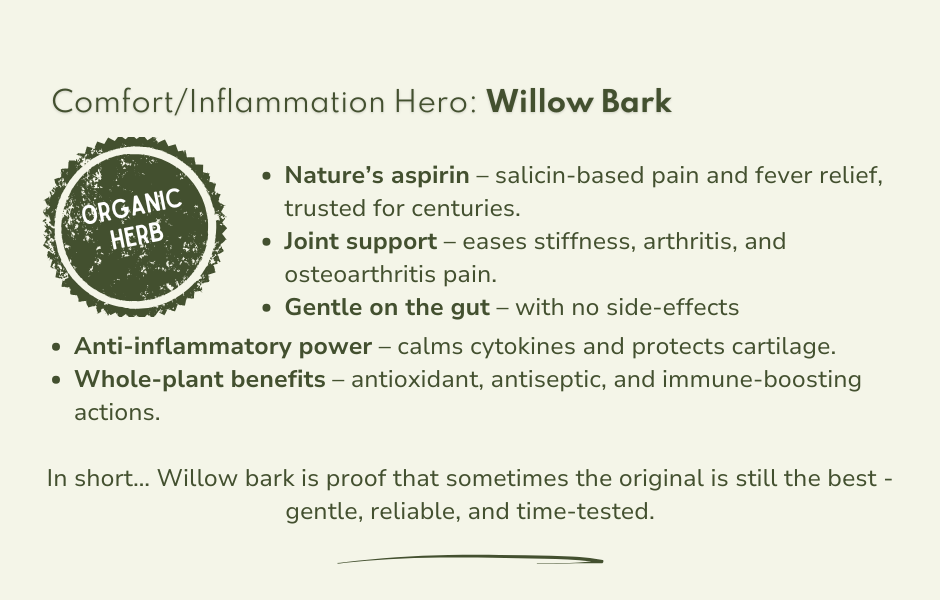
Its naturally occurring salicin and related plant compounds support the body’s normal inflammatory response, helping maintain comfortable movement without trying to switch that response off altogether.
Feed Willow Bark individually when straightforward salicylate-based comfort support is the priority. For broader, longer-term support, you’ll also find it paired with soothing Meadowsweet in DuoBute, or within TriBute when stronger short-course support is needed.
A familiar tree with a long-standing interest in creaky mornings.
*Please note this is a nutritional, functional horse food supplement and not veterinary medicine. See Dr Kellon's Horse Sense - Nutrition is not 'Alternative' Therapy
.
Where to find Willow in the EquiNatural range
You'll find Willow Bark paired with Meadowsweet in DuoBute , where the two herbs provide broader support for everyday comfort and easier movement.
It's also part of TriBute , our stronger short-course comfort formula for when the horse needs more acute support.
And you'll spot Willow in WildFed
too – although there it has a very different job, contributing bark and botanical variety to the wider edible hedgerow.
One familiar tree; three different reasons for inviting it into the feed bowl.
Feed guide
💧Organic willow bark tincture
Our human-grade, certified organic tinctures capture the plant's naturally occurring constituents in a concentrated, easy-to-feed liquid form.
- Salix alba, Bark
- Decocted 1:3 35%
- Organic grown
- Feed Guide - 6ml/100kg bodyweight, daily in feed.
🌿Organic dried willow bark
Grown, harvested and dried without the use of agri-chemicals, non-irradiated and GMO free - see our Quality page for Quality Management & Certification Documents.
- Salix alba, Bark, cut
- Organic w ild harvested
- Origin Poland
- Feed Guide - 5g/100kg bodyweight per day, thus for an average 500kg horse add 25g daily to feed.
Naturally occurring plant constituents
Including: Phenolic glycosides (salicin), tannins, flavonoids, and catechin.
Energetics - how Willow works
If you want the science, ‘energetic architecture’ explains how a herb is designed to work within the body - not just what’s in it, but the particular tissues and functions it has an affinity with.
Willow Bark is a cooling, salicylate-rich herb with a particular affinity for discomfort, stiffness and restricted movement.
Its central job is simple: support a balanced inflammatory response so the horse can feel more comfortable moving, without suggesting that inflammation itself is the enemy.
- Providing natural salicylate support - Willow contains salicin and related phenolic glycosides which are metabolised within the body to salicylate compounds. These help explain Willow's longstanding interest in inflammatory signalling and everyday comfort.
- Supporting comfortable movement - By supporting everyday comfort, Willow Bark fits particularly well where stiffness and easier movement are the priorities – while appropriate movement itself remains an important part of maintaining mobility.
- Protecting the tissues underneath - Willow Bark also contains flavonoids and polyphenols that contribute antioxidant support, helping protect tissues from the oxidative strain associated with work, ageing and normal inflammatory activity.
Big picture
Willow Bark is a focused comfort herb with one clear purpose: support the inflammatory conversation and help maintain comfortable, willing movement.
Clinical considerations
- Pregnant or nursing mares - always seek veterinary advice before feeding.
- If your horse is receiving anticoagulant, NSAID, pain-relieving or anti-inflammatory medication, check with your vet before feeding Willow Bark.
- Willow Bark naturally contains salicin and related salicylates. Salicylic acid is controlled under equestrian competition rules, so always check the current rules for your governing body before competing.
Willow bark in history & tradition
Before the pharmacy shelves were stacked with aspirin, there was willow bark.
It's one of those familiar trees we can walk past without giving it much thought - yet behind that quiet riverside presence sits a remarkable history - one that eventually helped shape the contents of the modern medicine cupboard.
Long before laboratories became involved, willow had a place in traditional medicine. Ancient Greek and Roman accounts describe uses for its leaves and bark, including preparations for pain and other complaints. People were paying attention to this tree centuries before anyone knew what salicin was.
During the nineteenth century, chemists began identifying willow’s constituents, including salicin, and investigating the chemistry behind its longstanding reputation. That work became part of the wider scientific story leading to aspirin. Willow bark and aspirin are different preparations, but their histories are closely connected.
What I like about willow’s story is that it began with people noticing things. Gathering bark, making preparations, recording their experiences and passing that knowledge on. Later came the lab questions about what was happening and why.
From a tree beside the water to a place in medical history - willow has had quite an influence for something that looks so content simply trailing its branches in the breeze.
Willow FAQs
How do I know if Willow Bark is right for my horse?
We'd look at Willow Bark when the main picture is everyday stiffness or reluctance to move comfortably, and you want straightforward, single-herb support.
Its naturally occurring salicin and related plant compounds support the body's normal inflammatory response, making Willow particularly useful where comfort and easier movement are the priority.
What's the difference between Willow Bark and DuoBute?
Think single herb versus broader everyday comfort formula.
- Willow Bark provides focused salicylate-rich support.
- DuoBute pairs Willow with Meadowsweet, giving us a more rounded approach to ongoing comfort – particularly when we want the two herbs working together rather than Willow doing the job alone.
If straightforward Willow support fits the horse, keep it simple.
If the comfort picture needs a little more breadth, that's where we'd usually move to DuoBute.
When would I choose TriBute instead?
TriBute is our stronger, short-course option for times when the horse needs more immediate comfort support.
So we'd broadly think:
- Willow Bark → simple, individual everyday support
- DuoBute → broader ongoing daily support
- TriBute → stronger short-course support when things have flared
Can I feed Willow Bark alongside pain medication?
This is one occasion where we wouldn't automatically layer.
Willow naturally contains salicylates, so if your horse is already receiving an NSAID or other prescribed pain-relieving or anti-inflammatory medication, speak to your vet before adding Willow Bark.
The same applies if your horse is taking anticoagulant medication.
Can competition horses have Willow Bark?
Willow contains naturally occurring salicylates and salicylic acid is controlled under equestrian competition rules, so it's not automatically competition-safe.
Always check the current rules for your governing body and allow an appropriate withdrawal period before competing.
Lovely tree. But still capable of upsetting the rule book.
© EquiNatural 2026. All content, formulations, and materials are original works protected under copyright, and are for personal study only. Content cannot be re-published or duplicated for commercial use.
