
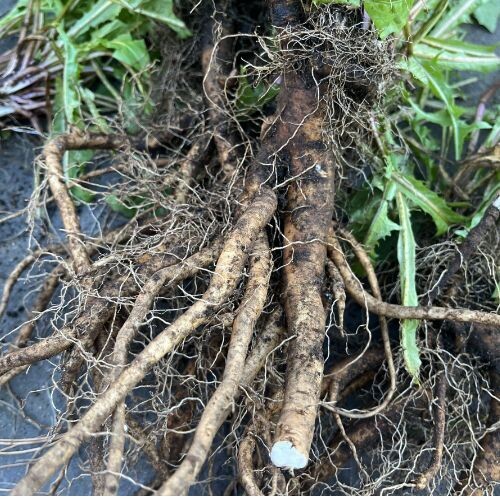
DANDELION ROOT for Horses (Taraxacum officinale) | Liver Health & Digestive Support
Benefits of Dandelion Root for Horses
The root that does it all — dandelion supports liver detoxification, bile flow, and digestive balance, helping the body clear waste and maintain healthy metabolism. Deeply nutritive and restorative, it’s a true herbal workhorse that keeps internal systems running smoothly from cell to circulation.
Ideal for nutritional use as part of a liver, metabolic, or digestive-support routine.
Please note this is a nutritional, functional food supplement and not veterinary medicine. For more on this, see Dr Kellon's Horse Sense - Nutrition is not 'Alternative' Therapy .
Find Dandelion in the EquiNatural range
Here’s where you’ll find dandelion in our supplement support for horses:
- BioCARE - for antimicrobial cleansing
- BreathePlus - for deep respiration support
- EyeTonic - restorative support for sensitive or challenged eyes (ERU)
- JSTTonic - helps manage the musculoskeletal challenges of arthritic changes
- LiverCARE - protects and supports detox pathways and metabolic balance
Composition & Feed Guide
💧Organic Dandelion Root Tincture
Our human-grade, certified organic tinctures give you a ready-to-absorb potent source of phytonutrients at the highest-strength available, for immediate absorption straight into the bloodstream and to the body’s cells.
- Taraxacum officinalis Radix
- Decocted 1:3 45%
- Organically cultivated
~ Feed Guide - 6ml/100kg bodyweight, daily in feed.
🌿Organic Dried Dandelion Root
Grown, harvested and dried without the use of agri-chemicals, non-irradiated and GMO free - see our Quality
page for Quality Management & Certification Documents.
- Taraxacum officinalis Radix, Cut
- Fairwild Organic
- Origin Poland
~ Feed Guide - 5g/100kg bodyweight per day, i.e. 25g for a 500kg horse.
Functional Nutritional Value
Constituents: Vitamins A and B. Leaf: calcium, potassium, iron, carotenoids, coumarins. Root: potassium, calcium, phenolic acids, taraxocoside, inulin.
Footnotes
- Laboratory tested for identification and compliance to the British and European Pharmacopoeia standards.
- Human grade.
- Please be aware that if you're purchasing our dried botanicals for human use, our dried range is cut to appropriate sizes for feeding to horses.
- ♻️ Eco Note: Our packaging is recyclable and refillable.
- 🧊 Storage Tip: Keep cool and dry.
Clinical Considerations
Advisories
- Because bitters stimulate gastric secretions, introduce gradually over 3–5 days, especially in horses with known foregut sensitivity.
- Best fed alongside ad-lib forage, which helps buffer normal stomach acid during bitter herb use.
- May theoretically increase clearance of water-soluble medications due to its digestive- and liver-stimulating effects.
- Exercise care when used alongside strong hepatic medications (e.g. long-term NSAIDs or antibiotics) - supportive but should be monitored.
Contraindications
- Not recommended for horses with active gastric ulcers or suspected foregut pain, as bitters may increase stomach acid output.
- Avoid during pregnancy or lactation, as traditional herbal texts recommend caution with bitter tonics.
- Use with caution in horses on multiple liver-metabolised medications, as increased bile flow may influence absorption or processing.
Dandelion in History & Tradition
If there were ever a plant that deserved a public apology, it’s the dandelion.
Gardeners moan about it, horses nibble it, and children (and let’s be honest, most adults) can’t resist blowing those fluffy white seedheads into the wind like nature’s original confetti. Meanwhile poor dandelion quietly gets on with being one of the most generous, nutritious herbs we’ve had alongside our feet all along.
From its lion-mane flowers to its deep, stubborn taproot, dandelion is resilience personified. This plant digs in - literally - pulling minerals up from deep in the soil in a way most surface-dwellers can only dream of.
Herbalists, unsurprisingly, love it. Because while many see a weed, herbal tradition sees a food, a tonic, and a full-body spring clean, all rolled into one sunny little powerhouse.
A whole larder and apothecary in one plant
This is not just a lawn pest - every part of the dandelion has something to offer.
The leaves, especially in spring, are mineral-rich, slightly salty, and famous among herbalists for their gentle diuretic action. Unlike pharmaceutical diuretics which can flush out precious potassium, dandelion leaves actually give back what they help release - a kind of herbal “take one, leave one” system that only nature could design.
The roots are a different personality altogether: bitter, earthy, excellent roasted for a coffee alternative (without the jitters), and rich in inulin, a prebiotic fibre that feeds the good gut microbes. Traditional herbalists have used dandelion root to support digestion, liver function, and those sluggish-between-seasons feelings that tend to creep in after winter.
And then we have the flowers - cheerful, toning, and historically used to make dandelion wine, which, depending on the recipe, is said to lift the spirit both symbolically and also quite literally.
Indigenous communities across North America used dandelion extensively too as a springtime nutrient burst, a food after the lean months, and a support for everything from skin conditions to appetite issues. They all knew its value long before Western herbalism caught up.
A root with a soft spot for the liver
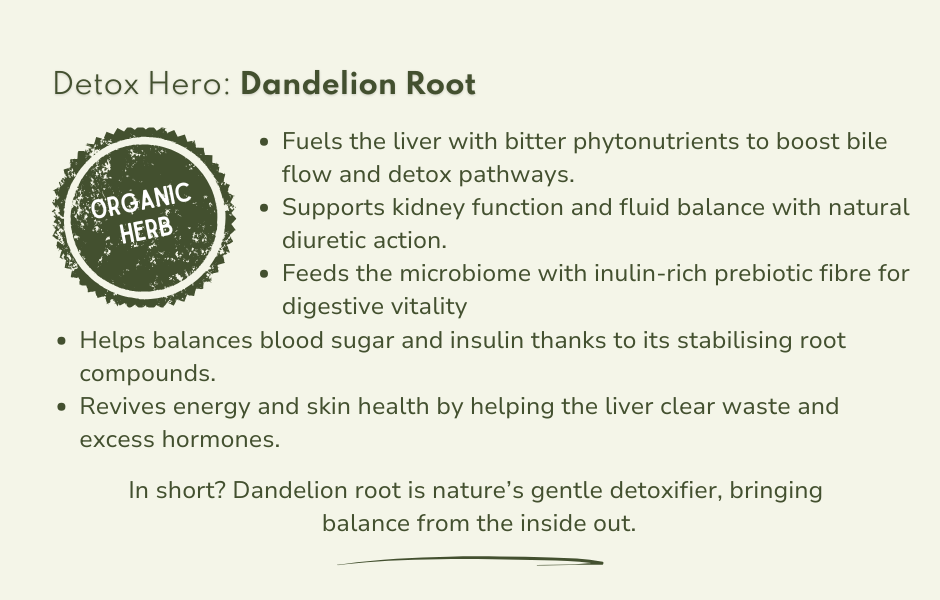
Dandelion root is widely loved as a liver and digestion tonic. And its bitterness isn’t just for show - those bitter compounds nudge the liver to get bile flowing again, which can help things move more smoothly through the digestive tract.
Herbalists reach for dandelion when they see signs of:
- Sluggish digestion
- Skin niggles linked to poor detox clearance
- Hormonal heaviness (the liver helps with hormone metabolising)
- After-rich-foods discomfort
- A general sense that the system needs a reset
Traditional Chinese Medicine uses dandelion to “clear liver heat,” while Ayurveda loves it for its cooling, cleansing nature. Same plant, different continents - but remarkably aligned wisdom.
Old wisdom
Research into dandelion root shows what herbalists have observed for generations:
- Inulin-rich roots feed beneficial gut bacteria
- Leaves support fluid balance thanks to their clever potassium content
- The plant as a whole contains compounds with natural calming and soothing qualities
- And some early studies suggest it may influence the body’s normal insulin response
Commission E in Germany even gave it official approval for uses such as digestive sluggishness and supporting healthy bile flow.
The plant that does it all
There are dandelion folk remedies for practically everything - from fresh sap dotted on warts, to roots roasted as a coffee, to leaves simmered in soups.
As herbalist David Hoffmann beautifully put it:
“Dandelion is a most valuable general tonic and perhaps the best widely applicable diuretic and liver tonic.”
Dandelion is the herbal equivalent of that unassuming friend who quietly shows up with exactly what you need - nourishment, grounding, or a gentle nudge to get things flowing again.
A humble weed, perhaps, but a pretty awesome one.
© EquiNatural 2026. All content is original work protected under copyright, and may not be re-published, duplicated, or rewritten for commercial use without permission.
