
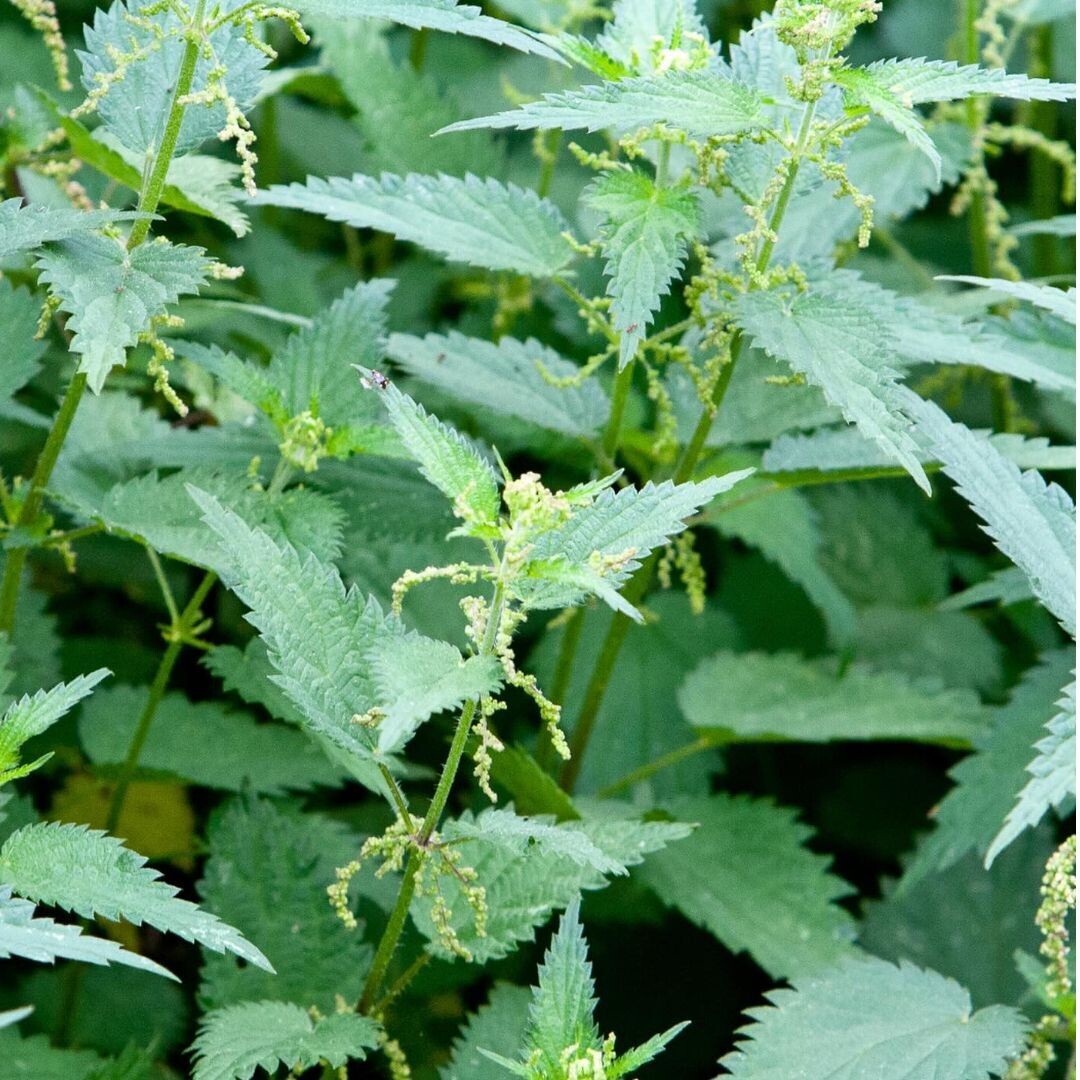
NETTLE for Horses (Urtica dioica) | Mineral-rich support for health & vitality
Benefits of organic Nettle for horses
Nettle is one of the most widely used herbs in traditional equine nutrition, valued for its naturally rich supply of minerals, chlorophyll, vitamins, and phytonutrients. Whenever horses are under pressure, whether it's seasonal challenges, recovery after illness, coat change, metabolic strain, or simply not looking quite as vibrant as they should, nettle is often one of the first herbs we think of.
It's easy to overlook because it's so common - in fact, I sometimes wonder if nettle suffers from being too familiar. Yet this humble plant is a true whole-body tonic.
Many owners reach for nettle when they want to nourish rather than push. Not because it targets one specific issue, but because it supports so many of the foundations that help a horse stay well - from nutritional status and metabolic health to skin, coat, kidneys, and seasonal resilience.
Simple, traditional, and exceptionally nutrient-dense. A perfect example of one of the most valuable herbs growing quietly in the hedgerow.
*Please note this is a nutritional, functional horse food supplement and not veterinary medicine. For more on this, see Dr Kellon's Horse Sense - Nutrition is not 'Alternative' Therapy
.
Find organic Nettle in the EquiNatural range
When it comes to our blends, it's more a case of where don’t we use nettle! It’s fair to say that along with milk thistle it’s up there as one of our core herbs that features in just about every one of our blends, including our complete CARE Immunity supplements.
Composition & feed guide
💧Organic nettle leaf tincture
Our human-grade, certified organic tinctures give you a ready-to-absorb potent source of phytonutrients at the highest-strength available, for immediate absorption straight into the bloodstream and to the body’s cells.
- Urtica dioica Folia (Stinging Nettle), Leaf
- Decocted 1:3 35%
- Organic Cultivated
- Feed Guide - 6ml/100kg bodyweight, daily in feed.
🌿Organic nettle herb (dried)
Grown, harvested and dried without the use of agri-chemicals, non-irradiated and GMO free - see our Quality page for Quality Management & Certification Documents.
- Urtica dioica Folia (Stinging Nettle), Herb
- Wild Harvested
- Origin Bulgaria
- Feed Guide - 5g/100kg bodyweight per day, i.e. 25g for a 500kg horse.
Functional nutritional value
Constituents: Vitamins A, C, E, and K, riboflavin, thiamine, minerals (calcium, chromium, magnesium, manganese, phosphorus, potassium, silica, iron, and zinc), protein, formic acid, serotonin, acetylcholine, flavonol glycosides (quercetin, kaempferol, and isorhamnetin), and chlorophyll.
Footnotes
- Laboratory tested for identification and compliance to the British and European Pharmacopoeia standards.
- Human grade.
- Please be aware that if you're purchasing our dried botanicals for human use, our dried range is cut to appropriate sizes for feeding to horses.
- ♻️ Eco Note: Our packaging is recyclable and refillable.
- 🧊 Storage Tip: Keep cool and dry.
Energetic architecture - the synergy behind Nettle
Energetic architecture explains how a herb supports the body's natural functions in a balanced and purposeful way.
Nettle occupies a unique position within the EquiNatural philosophy. Rather than being associated with one specific body system, it acts as a whole-body nourishment herb, providing a rich spectrum of minerals, vitamins, chlorophyll, and phytonutrients.
This is why it appears throughout so many of our formulations. Whether the focus is metabolism, skin, immunity, respiratory health, recovery, or seasonal support, the body relies on strong nutritional foundations to function well.
Think of Nettle as one of nature's great nutritional tonics - quietly supplying many of the raw materials that help the horse maintain resilience, vitality, and wellbeing over time.
Functional intent
Nettle is designed to support:
- Nutritional status and whole-body vitality
- Mineral replenishment and nourishment
- Healthy metabolic function
- Seasonal resilience and recovery
- Long-term wellbeing and adaptability
The goal is not targeted intervention, but foundational support that helps multiple systems function effectively.
Functional categories – support in action
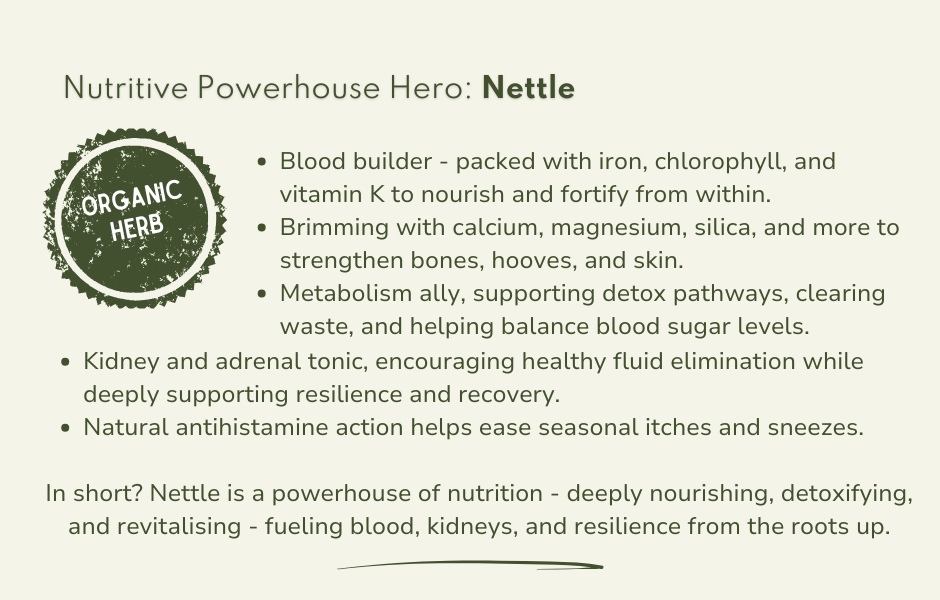
- Nutritional nourishment & mineral support - providing a naturally rich source of minerals, vitamins, amino acids, and chlorophyll that contribute to whole-body nutritional resilience.
- Metabolic & systemic vitality - supporting the body's natural metabolic processes and helping maintain vitality during periods of increased physiological demand.
- Seasonal resilience & recovery - traditionally valued as a spring tonic, helping support adaptation during seasonal transitions, coat change, and recovery periods.
- Skin, coat & connective tissue support - p roviding nutritional support for tissues that rely heavily on minerals, trace elements, and protein metabolism.
- Whole-body tonic support - helping support the wider systems that contribute to long-term health, resilience, and everyday wellbeing.
Big picture
The herbs that make the biggest difference are not always the most exotic, but the ones we've stopped paying attention to because they're so familiar.
That's Nettle, providing the nutritional foundations that allow other systems to function more effectively.
Clinical considerations
Advisories
Nettle has a long history of traditional use as a nourishing tonic herb and is often fed during periods of seasonal change, recovery, coat change, or when additional nutritional support is desired.
Particularly useful where broader mineral and phytonutrient support forms part of the nutritional plan.
Contraindications
- Seek veterinary guidance before use alongside anticoagulant medication due to potential interactions reported in human studies.
- Always check with your vet before feeding to pregnant or nursing mares.
Nettle in history & tradition
I sometimes wonder whether nettle suffers from being too common.
If it grew only on a remote Himalayan mountainside and cost £200 a kilo, we'd probably all be talking about it as one of the world's great superfoods.
Instead, it grows in every hedgerow, along field margins, beside muck heaps, and in all those places horse owners spend half their lives trying to keep tidy.
Perhaps that's why it's so easy to overlook. And yet, if I could only choose a handful of herbs to keep for the rest of my life, nettle would be right up there. It's that useful.
A plant that's fed, clothed, and nourished people for centuries
Long before nettle became a supplement, it was simply part of everyday life.
People ate it, made tea from it, fed it to livestock, added it to soups, used the fibres to make rope, cloth, fishing nets, and even sailcloth.
In fact, there was a time when nettle wasn't considered a weed at all - it was a resource, and a remarkably versatile one at that.
And that's one of the things I find so fascinating about it. Across completely different cultures and time periods, people kept finding practical uses for the same plant. Not because it was rare - but because it worked.
The sting that made it famous
Of course, if you mention nettles, most people immediately think of the sting.
We've all done it. Reached into a hedge without looking, or brushed past a patch in our shorts, then spent the next ten minutes wondering why nature felt the need to invent something quite so enthusiastic.
Those tiny hairs contain compounds that create the familiar burning sensation, and for some lucky people the sting seems to disappear in minutes. For others - and I'm firmly in this camp - it feels like it hangs around all day.
Yet even the sting became part of traditional herbal medicine. For centuries, people practised a technique known as urtication , deliberately applying fresh nettles to stiff or uncomfortable joints.
Not a therapy I'm rushing to volunteer for, I should add, but it does show just how highly people valued this plant.
What herbalists noticed long before science arrived
One of the reasons nettle appears throughout so many traditional herbal systems is that it never really fitted into a single category.
It wasn't just a digestive herb, or a skin herb, or a seasonal herb, or a mineral herb - it seemed to support people in lots of different ways at once.
Over time, herbalists began viewing nettle as a nourishing tonic - a plant that supplied the body with the raw materials it needed to maintain strength, resilience, and vitality.
Modern analysis helps explain why. Nettle is naturally rich in minerals, chlorophyll, amino acids, vitamins, and a remarkable array of plant compounds.
But long before laboratories started measuring nutrient levels, people simply noticed something important. Animals sought it out, people valued it, and it had a habit of appearing wherever nourishment and recovery were part of the conversation.
Why nettle still matters today
The herbs that make the biggest difference aren't always the rarest or most exotic.
Nettle doesn't arrive with dramatic claims, or an exotic origin story. It simply sits there in the hedgerow, doing what it's done for centuries. Providing nourishment, supporting resilience, helping the body through seasonal transitions, recovery periods, and the everyday demands of life.
Which is probably why you'll find nettle woven through so much of the EquiNatural range - because it's so foundational.
And sometimes the most valuable herbs are the ones growing quietly under our noses all along.
© EquiNatural 2026. All content is original work protected under copyright, and may not be re-published, duplicated, or rewritten for commercial use without permission.
