
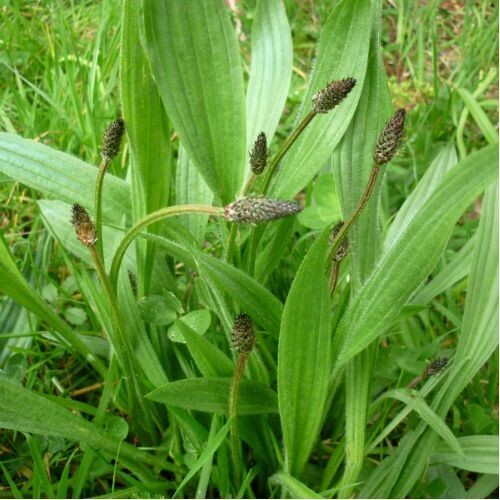
PLANTAIN for Horses (Plantago lanceolata) | Respiratory & Seasonal Support
Benefits of plantain herb for horses
Plantain? Tissue soothing. And at EquiNatural, we use it as gentle support for irritated airways – the horse who's coughing, reacting to pollen, or just more sensitive when the seasons change.
Plantain ( Plantago lanceolata ) is one of our favourite soothing respiratory herbs. Naturally rich in mucilage alongside plant compounds including aucubin and allantoin , it's traditionally valued for helping calm and protect delicate tissues wherever irritation has made them more reactive.
That's why you'll find Plantain in both KoffTonic and PollenTonic, where soothing the respiratory tract forms part of a much wider support picture.
But here's what makes this rather ordinary-looking hedgerow plant so interesting - plantain doesn't simply belong to the lungs. Its affinity is with the body's delicate linings – which is why herbalists have traditionally reached for it wherever tissues need a little soothing, protecting and restoring.
*Please note this is a nutritional, functional horse food supplement and not veterinary medicine.
For more on this, see Dr Kellon's Horse Sense - Nutrition is not 'Alternative' Therapy
.
Find Plantain in the EquiNatural range
Here’s where you’ll also find Plantain in our supplement support for horses:
- KoffTonic - natural support for the cough reflex and airway comfort
- PollenTonic - natural anti-allergen support for spring pollen allergy challenges
Overview - what do the lungs and the gut have in common?
At first glance, perhaps not very much - one deals with air, the other deals with food.
But look a little closer and they share something rather important - both depend upon delicate mucous membranes forming a protective boundary between your horse and the outside world.
- Every breath brings particles, dust and pollen into contact with the respiratory tract.
- Every mouthful of forage brings food, microbes and countless plant compounds into contact with the digestive tract.
And those surfaces have an extraordinary job. They need to remain permeable enough to carry out their normal functions, while simultaneously maintaining a healthy protective barrier against everything passing through.
And sometimes those tissues become irritated, which is where Plantain becomes interesting.
Its leaves contain naturally occurring mucilage – plant polysaccharides that take on a wonderfully soothing quality in contact with moisture – alongside tannins, flavonoids and compounds such as allantoin and aucubin.
Rather than thinking of Plantain as simply a “cough herb”, herbalists have traditionally valued it for its affinity with irritated tissue and vulnerable mucous membranes. That makes its seemingly enormous range of traditional uses suddenly rather less mysterious - respiratory tract, digestive tract, skin.
Different places – but the same underlying theme - soothe the surface, support the barrier, give irritated tissue a gentler environment in which to recover its normal function.
And that's what makes this ordinary-looking hedgerow plant so remarkable. Plantain isn't really a herb that does a hundred different things – it's an invaluable herb that does one rather lovely thing in a hundred different places.
Composition & feed guide
💧Organic plantain leaf tincture
Our human-grade, certified organic tinctures capture the plant's naturally occurring constituents in a concentrated, easy-to-feed liquid form.
- Plantago lanceolata (Plantain Ribwort), Leaf
- Infused 1:3 35%
- Organically Grown
- Feed Guide - 6ml/100kg bodyweight, daily in feed.
🌿Organic dried plantain leaf
Grown, harvested and dried without the use of agri-chemicals, non-irradiated and GMO free - see our Quality page for Quality Management & Certification Documents.
- Plantago lanceolata (Plantain Ribwort), Leaf
- Organic Cultivated/Wild Harvested
- Origin Poland
- Feed Guide - 5g/100kg bodyweight per day, i.e. 25g for a 500kg horse.
Footnotes
- Laboratory tested for identification and compliance to the British and European Pharmacopoeia standards.
- Human grade.
- Please be aware that if you're purchasing our dried botanicals for human use, our dried range is cut to appropriate sizes for feeding to horses.
- ♻️ Eco Note: Our packaging is recyclable and refillable.
- 🧊 Storage Tip: Keep cool and dry.
Functional nutritional value
Constituents: Allantoin, mucilage (polysaccharides), iridoid glycosides (including aucubin and catalpol), flavonoids (apigenin, luteolin), minerals (including significant zinc and potassium), and tannin.
"Energetics" - the science behind Plantain
When it comes to herbs and herbal formulations, you may have heard herbalists talk about energetics . It's simply the way we describe how a herb or formula has been designed to support the body in a balanced and purposeful way. The science helps us understand why that structure works.
Plantain is one of herbal medicine's great tissue-soothing herbs, with a long tradition of supporting the delicate mucous membranes and protective surfaces that form the body's first line of defence.
How plantain works
Plantain combines soothing mucilage with protective plant compounds that work across several closely related aspects of tissue health.
- Supporting delicate mucous membranes
- Plantain's naturally occurring mucilage gives the herb its characteristic soothing quality, traditionally valued wherever delicate mucous membranes have become irritated or challenged. - Supporting healthy tissue integrity
- Compounds including allantoin, aucubin, and naturally occurring flavonoids have traditionally been valued for helping maintain healthy tissue integrity and supporting the body's normal repair processes. -
Supporting seasonal respiratory comfort
- Because the respiratory tract is continually exposed to pollen, dust, and other airborne particles, Plantain has long been used to help soothe the delicate airway tissues that bear the brunt of these everyday environmental challenges.
Big picture
Most people walk straight past plantain, yet herbalists have treasured it for centuries because they recognised a simple pattern: wherever the body has delicate protective surfaces that become irritated, Plantain has something useful to offer.
Whether that's the lungs, the gut, the skin, or elsewhere, the principle remains remarkably consistent - helping create the environment where healthy tissues can get on with the job.
Clinical considerations
Advisories
- If feeding alongside prescription medication and you're concerned about mucilage affecting absorption, check timing with your vet.
Contraindications
- None known within recommended dietary amounts.
- Seek veterinary guidance during pregnancy/nursing.
Plantain in history & tradition
I reckon Plantain is one of the most overlooked plants in the entire hedgerow, simply because it's almost too common - on footpaths, in paddocks, along roadsides, field margins, and basically growing wherever people and animals go.
In fact, there's an old saying - "Plantain follows man." And once you've noticed it, you start seeing it everywhere.
Plantain has been walking alongside us for an astonishingly long time. The Anglo-Saxons honoured it as one of the famous Nine Sacred Herbs, Dioscorides described it, Culpeper recommended it. Shakespeare even managed to slip it into Romeo and Juliet , where Romeo casually suggests it as a remedy for a broken shin.
Not many weeds can claim a literary career as well as a medicinal one.
Yet through all those centuries, herbalists stayed in the know - wherever delicate tissues had become irritated, plantain seemed to find its way into the herbal cupboard.
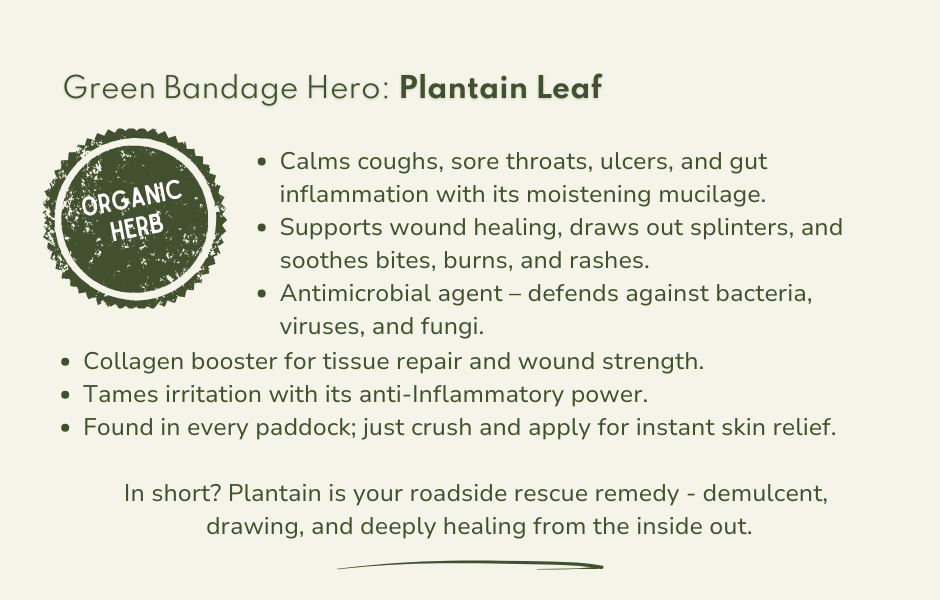
Nettle stings, cuts and grazes, insect bites, splinters, sore throats, unsettled digestion, coughs, sores... it was the original green first-aid kit.
It almost looked as though herbalists were using it for everything - but when you look a little more closely, a pattern began to emerge - soothe the surface, protect the tissue, create an environment for repair.
Long before anyone identified mucilage, allantoin, or aucubin, people had already worked out what Plantain seemed to do best - crushed leaves felt soothing against irritated skin, and teas appeared comforting for sore throats.
The plant seemed to have a particular affinity for delicate linings throughout the body, and modern science has since helped explain why. But once again, the laboratories arrived rather later than the herbalists.
A quiet hero herb...
Plantain has been silently growing beneath our feet all along, not producing spectacular flowers but just patiently waiting to be useful.
Perhaps that's why it's remained one of herbal medicine's quiet heroes for so many centuries – because wherever the body has a delicate surface that needs something gentle, Plantain seems to know what to do.
Plantain FAQs
Is Plantain just a herb for coughs?
Not at all. While Plantain has a long history of supporting horses with coughs and seasonal respiratory irritation, that's only part of the story.
Wherever the body has delicate linings that become irritated – whether that's the airways, the digestive tract, or the skin - plantain has traditionally been used for gentle support.
That's why we think of it as a tissue-soothing herb first, and a respiratory herb second.
My horse is more sensitive to pollen every year. Could Plantain help?
Yes. Plantain has traditionally been used to help soothe the delicate lining of the airways during these seasonal challenges, which is why you'll find it in both PollenTonic and KoffTonic.
Rather than trying to fight the pollen itself, the aim is to help support the tissues that come into contact with it every day.
Can Plantain be fed every day?
Yes. Plantain is a wonderfully gentle herb that's well suited to longer-term use, and horses will happily graze on it.
© EquiNatural 2026. All content is original work protected under copyright, and may not be re-published, duplicated, or rewritten for commercial use without permission.
