
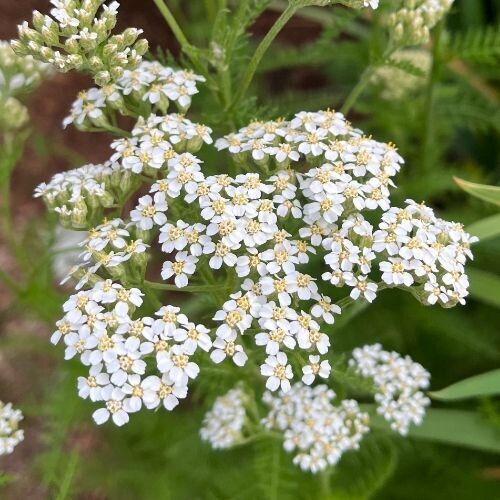
YARROW for Horses (Organic)
Yarrow is our versatile seasonal herb for horses who become more sensitive when pollen levels rise.
Does your horse seem to notice every shift in the season? As pollen rises, grass changes or temperatures swing, perhaps their airways become more sensitive, their skin less settled, or they simply seem less comfortable in themselves.
Meet yarrow. Rather than having one job, Yarrow traditionally supports circulation, mucous-membrane comfort and the body’s normal inflammatory response - making it especially useful when the seasonal picture doesn’t sit neatly in one box.
Feed it individually when that broader balancing support is the priority, or find it lending its steady hand across several EquiNatural blends.
*Please note this is a nutritional, functional horse food supplement and not veterinary medicine. See Dr Kellon's Horse Sense - Nutrition is not 'Alternative' Therapy .
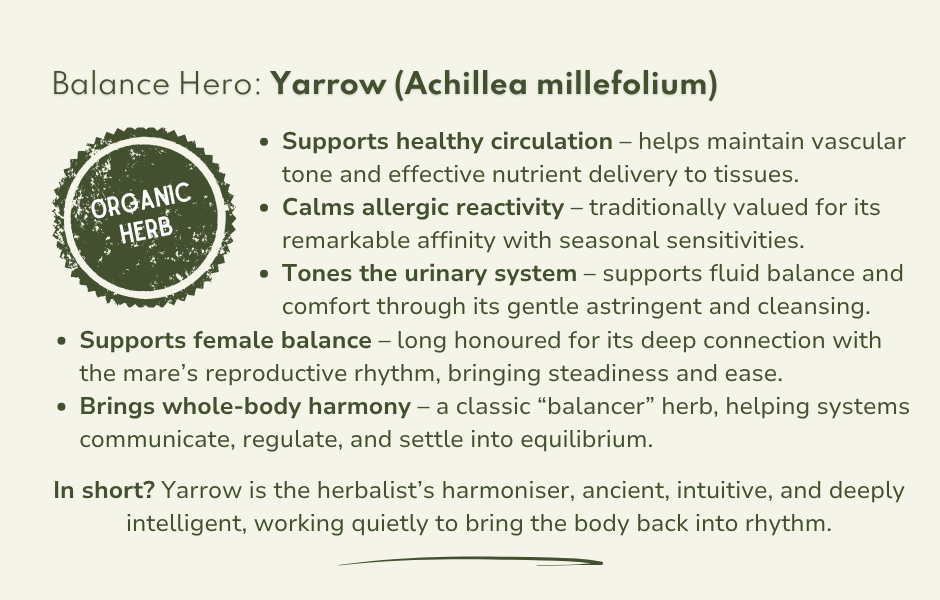
Where to find Yarrow in the EquiNatural range
You'll find Yarrow in BreathePlus and PollenTonic , where its traditional affinity for circulation, mucous membranes and seasonal responses makes it a natural fit for respiratory and environmental support.
It's also part of GutBitters , contributing its bitter, aromatic character to digestive support, and MellowMare , where its broader traditional relationship with circulation and the female reproductive system earns it a rather different job.
Same Yarrow. Different setting.
Feed guide
💧Organic yarrow herb tincture
Our human-grade, certified organic tinctures capture the plant's naturally occurring constituents in a concentrated, easy-to-feed liquid form.
- Achillea millefolium (Yarrow), Flowering tops
- Distilled/Infused 1:3 35%
- Organic Grown
- Feed Guide - 6ml/100kg bodyweight, daily in feed.
🌿Organic dried yarrow flowering tops
Grown, harvested and dried without the use of agri-chemicals, non-irradiated and GMO free - see our Quality page for Quality Management & Certification Documents.
- Achillea millefolium (Yarrow), Flowering Tops
- Organic Cultivated
- Origin UK
- Feed Guide - 5g/100kg bodyweight per day, i.e. 25g for a 500kg horse.
Footnotes
- Laboratory tested for identification and compliance to the British and European Pharmacopoeia standards.
- Human grade.
- Please be aware that if you're purchasing our dried botanicals for human use, our dried range is cut to appropriate sizes for feeding to horses.
- ♻️ Eco Note: Our packaging is recyclable and refillable.
- 🧊 Storage Tip: Keep cool and dry.
Naturally occurring plant constituents
Including: Volatile oils, sesquiterpene lactones, flavonoids including apigenin and luteolin, tannins, phenolic acids, bitter compounds and naturally occurring coumarins.
Energetics - how Yarrow works
If you want the science, ‘energetic architecture’ explains how a herb is designed to work within the body - not just what’s in it, but the particular tissues and functions it has an affinity with.
Yarrow is an aromatic, astringent herb with a particular affinity for circulation, mucous membranes and the body’s response to environmental change.
Think of it as helping the body manage what should move, what should stay contained and how strongly the tissues need to respond.
- Supporting healthy circulation - Yarrow has a long traditional relationship with circulation, while its flavonoids and other plant compounds help explain continuing interest in its vascular effects. Here, we're using that broader circulatory character as part of Yarrow's overall seasonal-support picture.
- Toning tissue boundaries - Its tannins provide a gently astringent action, supporting tone within mucous membranes and other tissues where moisture, secretions or sensitivity have become a little excessive.
- Steadying the seasonal response - Yarrow’s flavonoids and aromatic compounds support a balanced inflammatory response, giving it a useful place where pollen, temperature changes or other environmental triggers affect the airways, skin or general comfort.
Big picture
Yarrow’s many traditional uses aren’t as disconnected as they first appear. Circulation, mucous-membrane tone and inflammatory signalling all influence how the body responds at its boundaries.
Keep things moving, keep the tissues appropriately toned and keep the response in proportion.
Clinical considerations
- Always seek veterinary advice before feeding to the pregnant/nursing mare.
Yarrow in history & tradition
Yarrow is one of those plants you can walk past a hundred times before someone points it out. Then suddenly you see it everywhere - feathery leaves in the grass, little clusters of flowers beside the path. A familiar wildflower with a rather grand backstory.
Its botanical name, Achillea millefolium , carries two little clues. Millefolium means “a thousand leaves”, a perfect description of that finely divided foliage. Achillea takes us into Greek legend, where Achilles was said to have used the herb to tend his soldiers’ wounds. Quite a connection for something growing quietly at the field edge.
That wound-herb reputation followed yarrow through the centuries. Old names such as soldier’s woundwort and nosebleed tell us something about the jobs people once gave it. Common names can be little scraps of history in themselves - no hefty herbal textbook required.
But yarrow never stayed just in the battlefield medicine bag. European herbal traditions also made room for it in preparations for digestive discomfort, poor appetite and menstrual cramps. The same plant appeared in several corners of the household herb cupboard, which helps explain why herbalists have always found it tricky to sum up in one sentence.
And that’s what I like about it - in fact, yarrow is one of my favourite herbs - yarrow arrives with a whole collection of stories. Its history reminds us how closely people once observed the ordinary plants around them, gathering knowledge alongside the flowers.
Here at EquiNatural, its place is mainly in seasonal allergy support - a different chapter from the old soldier’s woundwort story, but still very much part of our appreciation for this versatile herb.
A thousand leaves, several centuries of stories, and still looking for all the world like “just a bit of something in the grass”.
Yarrow FAQs
How do I know if Yarrow is the right herb for my horse?
We'd look at Yarrow when the picture feels seasonal or changeable.
Your horse might become more sensitive as pollen rises, their airways or skin notice changes in the environment, or they simply seem less comfortable when grass, weather and seasons are shifting around them.
Yarrow's traditional strengths lie across circulation, mucous-membrane tone and a balanced inflammatory response, which is exactly why it can be useful when several of those little clues appear together.
Is Yarrow mainly a respiratory herb?
No – although respiratory comfort is one of the places we particularly value it.
Yarrow's traditional relationship with mucous membranes, circulation and the body's normal inflammatory response makes it an interesting supporting herb when airways seem more sensitive to pollen and other seasonal changes.
That's why you'll find it in BreathePlus and PollenTonic, where Yarrow works as one member of a wider herbal team.
Why is Yarrow in so many different EquiNatural blends?
Its different traditional uses aren't quite as unrelated as they first appear.
You'll find Yarrow in BreathePlus, PollenTonic, GutBitters and MellowMare – formulas doing apparently very different jobs.
But underneath them sit some familiar themes: healthy circulation, tissue tone, comfortable mucous membranes and a proportionate response to change.
We're not asking Yarrow to become four different herbs - we're simply making use of the same versatile character in four different settings.
Should I choose dried Yarrow or the tincture?
Either – choose whichever works best for your horse and your routine.
The dried herb gives you the whole flowering tops in their traditional form, while the tincture provides Yarrow's naturally occurring constituents in a concentrated, easy-to-feed liquid.
Same herb, different presentation.
© EquiNatural 2026. All content is original work protected under copyright, and may not be re-published, duplicated, or rewritten for commercial use without permission.
