
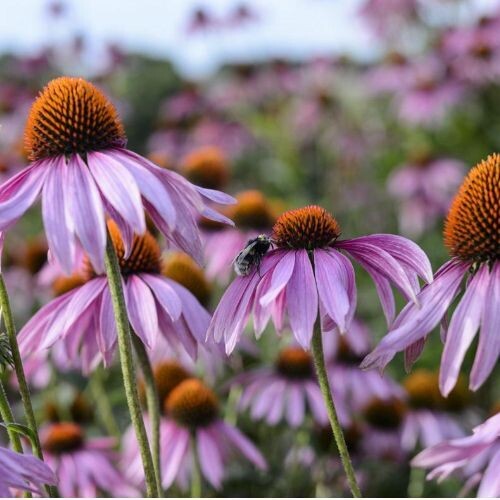
ECHINACEA for Horses (Echinacea purpurea) | Immune Support & Natural Resilience
Benefits of Echinacea for Horses
Echinacea brings together a rich spectrum of bioactive plant compounds to help maintain immune balance and natural resilience. Long valued for its botanical strength and deep-rooted tradition, this purple coneflower offers gentle, supportive nourishment when your horse needs steady, everyday immune support.
Please note this is a nutritional, functional food supplement and not veterinary medicine. For more on this, see Dr Kellon's Horse Sense - Nutrition is not 'Alternative' Therapy
.
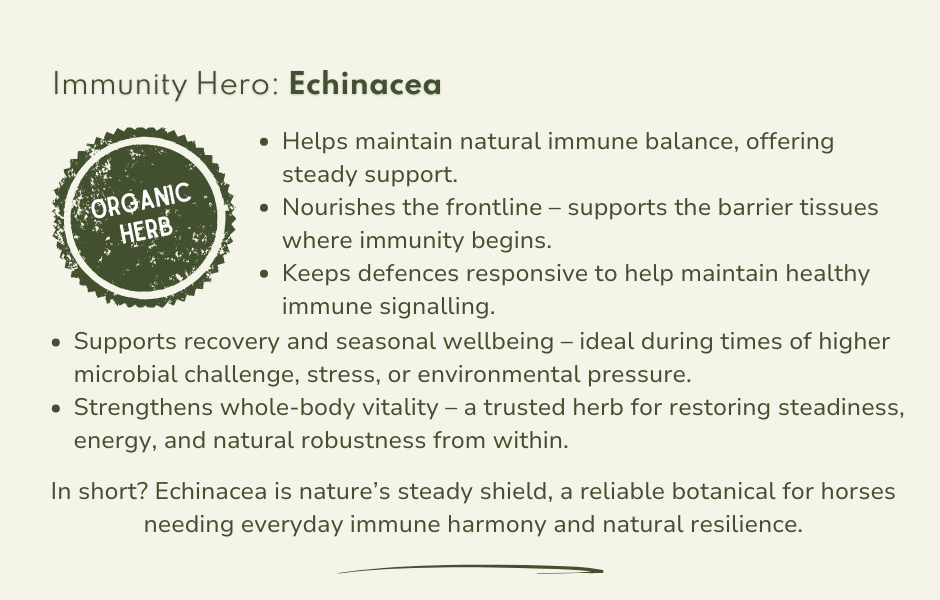
Find Organic Echinacea in the EquiNatural range
Here’s where you’ll also find echinacea in our supplement support for horses:
- BioCare - antimicrobial-cleansing, antibiotic-balancing, immunity-restoring
- BreathePlus - airway-clearing, lung-soothing, allergy-calming
- EyeTonic - eye-nourishing, comfort-calming, clarity-balancing
- LiverCARE - liver-balancing, toxin-clearing, vitality-renewing
- LKLCARE - liver, kidneys, lymph synergy
- LymeCARE - a comprehensive, regenerative nutritional plan for equine Lyme Disease
- LymphCARE - lymph congestion, tissue support, comfort restored
- OptimaCARE - a comprehensive, regenerative, nutritional 3-stage full-body detox for equine vitality
Composition & Feed Guide
💧Organic Echinacea Tincture
Our human-grade, certified organic tinctures give you a ready-to-absorb potent source of phytonutrients at the highest-strength available, for immediate absorption straight into the bloodstream and to the body’s cells.
- Echinacea purpurea (Purple Cone Flower), Herb
- Decocted / Infused1:3 25%
- Fresh Organic
~ Feed Guide - 6ml/100kg bodyweight, daily in feed.
🌿Organic Dried Echinacea Herb
Grown, harvested and dried without the use of agri-chemicals, non-irradiated and GMO free - see our Quality
page for Quality Management & Certification Documents.
- Echinacea purpurea (Purple Cone Flower), Herb
- Organic Cultivated
- Origin Germany
~ Feed Guide - 5g/100kg bodyweight per day, i.e. 25g for a 500kg horse.
Functional Nutritional Value
Constituents: Polysaccharides, glycoproteins, echinacoside, echinacin, polyacetylenes, betaine, caffeic acid glycosides, inulin, sesquiterpene esters, alkamides, volatile oils, flavonoids.
Footnotes
- Laboratory tested for identification and compliance to the British and European Pharmacopoeia standards.
- Human grade.
- Please be aware that if you're purchasing our dried botanicals for human use, our dried range is cut to appropriate sizes for feeding to horses.
- ♻️ Eco Note: Our packaging is recyclable and refillable.
- 🧊 Storage Tip: Keep cool and dry.
Clinical Considerations
Advisories
- Echinacea is generally considered safe for horses and is well tolerated when used at recommended nutritional levels.
- Safe for long-term use in most horses, though periodic breaks are recommended (e.g. 2–3 weeks on, 1 week off) for optimal responsiveness.
Contraindications
- Not recommended for pregnant or nursing mares, following general caution with immune-modulating botanicals.
- Always seek veterinary advice for horses taking immune-suppressant medication(e.g. corticosteroids, certain autoimmune drugs).
- Use caution in horses with autoimmune disorders where immune stimulation may not be appropriate for the individual case.
- Not advised during episodes of acute allergic flare until the horse is stabilised - may be reintroduced later as supportive care.
Echinacea in History & Tradition
If you’ve ever walked past a garden full of those cheerful purple coneflowers and thought, “Pretty!” - well, Echinacea would like you to know it’s far more than a pretty face. This plant has history, depth, a CV as long as your arm - and a slightly spiky personality (literally… the name comes from the Greek for “hedgehog”).
Echinacea has been part of North American herbal traditions for hundreds of years, long before it made its way into modern formulas. Indigenous communities used the roots and flowering tops for all manner of protective, comforting, and skin-soothing purposes. Chewed fresh, brewed into infusions, mashed into poultices - it was a real multipurpose stalwart long before the rest of us caught on.
Fast-forward to the physicians in the late 1800s, who adored it so much they practically made it their mascot. Cue Echinacea’s big leap across the Atlantic, followed by a century of debate about which species is “best” - a conversation that can get surprisingly spirited.
Team Angustifolia swear the root is the superior choice, whereas Team Purpurea point to the mountains of research done on the fresh aerial parts. But honestly? Both sides have a point - they simply shine in different ways.
One thing most herbalists agree on is this: Echinacea works best as a whole plant , not when you take one molecule and wave it around like a trophy. Its natural constituents - polysaccharides , alkamides , flavonoids - behave a bit like a well-rehearsed ensemble cast, whereas separating them is like asking the violins to play the entire symphony alone. Possible? Yes. Ideal? Not really.
Science has poked around quite a bit, mostly at E. purpurea, exploring how it interacts with white blood cells, how it influences immune signalling, and how it helps barrier tissues do their job. But the challenge is that every study uses a different mix of species, parts, extraction methods, timings, and dose logic. So trying to compare them is a bit like comparing apples to hedgehogs - related only by spikiness.
One of the most fascinating bits - and something the popular press rarely mentions - is Echinacea’s traditional role as a hyaluronidase inhibito r . In simple terms: hyaluronic acid is the lovely, gloopy, cushioning substance your tissues make to stay plump, protected, and well-structured. Hyaluronidase is the enzyme certain bacteria, insects, and venomous nasties use to break that down so they can move through tissues more easily.
Echinacea steps in and says, “Absolutely not.”
Which explains why so many Indigenous communities used fresh root and poultices for stings, bites, and irritated skin - long before anyone named the enzymes involved.
Now… we need to talk about quality, because echinacea is also famously misunderstood. In 2002, a consumer investigation found that most commercial “echinacea” products didn’t even contain Echinacea at all. The real angustifolia root should give you a unmistakable tongue tingle- a sort of prickly, buzzy sensation that panics first-timers but actually means, “Yes, this is the real deal.” No tingle = no angustifolia.
So, where does all this leave us?
Echinacea is one of those herbs that has stood the test of time for a reason. It’s packed with natural complexity, rooted in deep tradition, admired by both herbalists and researchers (even if they argue about species), and respected for its ability to offer natural resilience and support when things feel a bit under par.
Not bad for a purple flower with a hedgehog for a centre.
© EquiNatural 2026. All content is original work protected under copyright, and may not be re-published, duplicated, or rewritten for commercial use without permission.
