
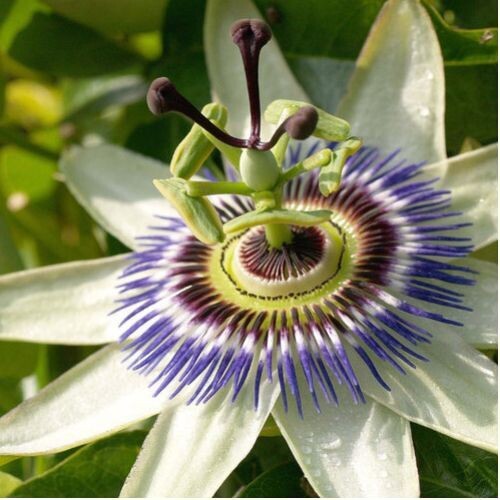
PASSIONFLOWER for Horses (Passiflora incarnata) | Anxiety & Nervous Tension Support
Benefits of Passionflower for Horses
The calm within the chaos - Passionflower ( Passiflora incarnata ) is one of herbal medicine's great anxiolytic nervines, traditionally valued where anxiety, nervous tension and an over-busy mind make it difficult to settle.
In plain English? It's the herb herbalists have long reached for when the nervous system simply needs the volume turning down.
That's why you'll find it in both StressTonic and MellowMare, where nervous tension forms part of a much bigger picture.
A stunning flower with a remarkable affinity for the nervous system, it works where nervous tension hits hardest. Think less “switching off” - and more "turning down".
*Please note this is a nutritional, functional horse food supplement and not veterinary medicine. For more on this, see Dr Kellon's Horse Sense - Nutrition is not 'Alternative' Therapy .
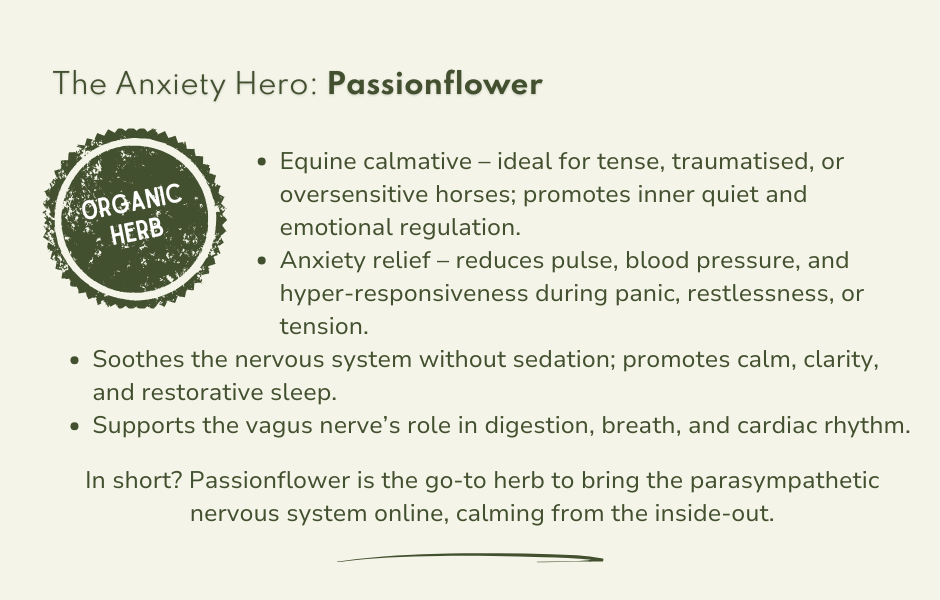
Find organic Passionflower in the EquiNatural range
Here’s where you’ll also find Passionflower in our supplement support for horses:
- MellowMare - natural organic hormone harmony for calmer, happier mares
- StressTonic - natural support for equine chronic stress resilience
Overview - understanding nervous tension in horses
That's the interesting thing about Passionflower.
When we're looking at tension or anxiety, the aim isn't to sedate. We still want to be aware of our surroundings, able to think, learn and respond - we'd just rather the nervous system wasn't reacting quite so loudly to everything around it.
This is where Passionflower has earned such an interesting reputation in traditional herbalism - it's actually my goto if I'm having a "moment" - a tincture short of passiflora and verbena and I'm usually feeling more like myself again within 20 minutes or so.
Its naturally occurring plant compounds include flavonoids such as vitexin and apigenin, alongside GABA and other constituents associated with nervous-system signalling.
But the easiest way to understand Passionflower isn't through its constituent list. When it comes to horses, think of the horse whose brain has twenty tabs open at once:
- The rustle in the hedge.
- The horse leaving the yard.
- The tractor in the distance.
- What's happening behind them.
- What's happening over there.
- And possibly the monster only they can see.
Passionflower doesn't close the tabs - it simply quietens them enough that the horse can think clearly again.
Passionflower has traditionally been used where that nervous activity needs softening - helping support the transition from constant vigilance towards a quieter, more settled state.
And because the nervous system doesn't exist in isolation, that matters beyond behaviour. The same autonomic pathways involved in alertness and relaxation also communicate with digestion, heart rate, breathing and the wider stress response.
Perhaps that's why herbalists have continued reaching for Passionflower for generations.
It isn't about taking away the world around us - it's about helping the world feel a little less loud.
Composition & feed guide
💧Organic passionflower herb tincture
Our human-grade, certified organic tinctures give you a ready-to-absorb potent source of phytonutrients at the highest-strength available, for immediate absorption straight into the bloodstream and to the body’s cells.
- Passiflora incarnata (Passion Flower), Herb
- Infused 1:3 35%
- Organically Grown
- Feed Guide - 6ml/100kg bodyweight, daily in feed.
🌿Organic passionflower herb
Grown, harvested and dried without the use of agri-chemicals, non-irradiated and GMO free - see our Quality page for Quality Management & Certification Documents.
- Passiflora incarnata (Passion Flower), Herb
- Organic Cultivated
- Origin France
- Feed Guide - 5g/day, i.e. 25g for a 500kg horse.
Footnotes
- Laboratory tested for identification and compliance to the British and European Pharmacopoeia standards.
- Human grade.
- Please be aware that if you're purchasing our dried botanicals for human use, our dried range is cut to appropriate sizes for feeding to horses.
- ♻️ Eco Note: Our packaging is recyclable and refillable.
- 🧊 Storage Tip: Keep cool and dry.
Functional nutritional value
Constituents: Flavonoids including apigenin, luteolin, scopoletin, 0.825% apigenin and luteolin glycosides, vitexin, isovitexin and their C-glycosides, kaempferol, quercetin, and rutin; maltol; cyanogenic glycosides (gynocardin) ; indole alkaloids including up to 0.1% – 0.9% harman alkaloids including harmane, harmaline, and harmol; amino acids (including GABA); fatty acids (including linoleic, linolenic, palmitic), phenolic acid; formic and butyric acids; coumarins; phytosterols; volatile oil
"Energetics" - the science behind Passionflower
When it comes to herbs and herbal formulations, you may have heard herbalists talk about energetics . It's simply the way we describe how a herb or formula has been designed to support the body in a balanced and purposeful way. The science helps us understand why that structure works.
Passionflower is traditionally used to support the nervous system when it has become stuck in a state of heightened alertness.
Think of it as helping turn down the internal volume, allowing the nervous system to move from constant vigilance towards a calmer, steadier rhythm.
How Passionflower works
Unlike many herbs that work across several body systems, Passionflower has a remarkably clear affinity for one - the nervous system. Yet because the nervous system communicates with virtually every organ in the body, its influence extends much further.
- Supporting nervous system balance
- Naturally occurring flavonoids, alkaloids, and compounds associated with GABA signalling help support the pathways involved in calmness, relaxation, and emotional steadiness without simply suppressing normal awareness. - Supporting the gut–brain connection
- The nervous system and digestive tract are in constant conversation. By helping support healthy autonomic nervous system function, Passionflower may also help maintain comfortable digestion when nervous tension forms part of the picture.
Big picture
One of the things I've noticed over the years is that anxious horses aren't always frightened horses. This was also my Murf back in the early days - simply processing far more information than he could manage.
Every rustle, every movement, every tiny change competes for attention until the nervous system never quite gets chance to switch off.
Passionflower doesn't take those experiences away - it simply helps turn down the background noise.
And once the nervous system begins to settle, it's often remarkable how many other systems begin settling alongside it.
Clinical considerations
Advisories
- Passionflower is a nutritional nervine that supports calmness and nervous-system balance.
- Suitable for short- or longer-term use as part of a stress, hormonal, or behavioural support plan.
- Beneficial for horses showing tension-linked digestive tightness, as passionflower supports gut–nerve regulation.
Contraindications
- Not permitted in competition. Passionflower is considered a controlled/banned substance due to its mild sedative and anxiolytic actions.
- Not recommended for pregnant or nursing mares because of historic caution with sedative and uterine-modulating botanicals.
- Avoid in horses with known bradycardia (slow heart rate) or unusually low blood pressure.
- Not suitable for horses with advanced liver disease without veterinary oversight, due to its mild hepatic metabolism involvement.
Competition Advisory
- Passionflower is now listed as a controlled/forbidden substance by most governing bodies (FEI, BE, BD, etc.).
- Always stop feeding well within the withdrawal window for your discipline.
Passionflower in history & tradition
The flower that looks as though it has far too much going on...
Have you ever really looked at a Passionflower?
Not just glanced at one... actually looked. It looks like somebody gave a botanist an entire box of geometry equipment and said, "Go on then... have fun."
Frilly petals, curly tendrils, a spectacular crown of delicate filaments - little structures pointing in every conceivable direction. If any flower ever looked as though it had twenty tabs open at once, Passionflower might be it.
Which makes it rather deliciously ironic that herbalists have spent centuries reaching for it when we have twenty tabs open at once.
A flower with an extraordinary story
Passionflower isn't native to Europe at all - it grows naturally throughout the Americas, where Indigenous peoples had long recognised its value before European explorers ever encountered it.
When Spanish missionaries first saw the flower in the sixteenth century, they were completely captivated.
Its extraordinary structure reminded them of the story of the Passion of Christ, and they began assigning symbolic meaning to almost every part of the flower.
The corona became the crown of thorns. The five stamens represented the wounds. The tendrils symbolised the whips. Even its name - Passiflora - comes from that remarkable interpretation.
Whether you share the symbolism or not, it's hard not to admire the imagination behind it.
What herbalists noticed
While artists and missionaries marvelled at the flower's appearance, herbalists were paying attention to something rather different.
They noticed what happened after people took it - and generation after generation came to remarkably similar conclusions - passionflower didn't seem to dull the mind.
It didn't knock people out - instead, it seemed to quieten the constant internal chatter that made proper rest, clear thinking, and settled emotions so difficult.
I always think that's a much nicer way to understand this herb. Not as something that switches the brain off, but as something that simply turns the volume down a notch.
Long before anybody understood GABA signalling or neurotransmitters, herbalists had already observed exactly the same thing.
Why Passionflower still matters today
Very few anxious horses are frightened all the time. More often, they're simply processing... everything.
Perhaps that's why Passionflower has remained so highly regarded for generations. Not because it makes the world disappear - but because it helps the nervous system stop trying to listen to all of it at once.
And in today's increasingly busy world, I suspect horses aren't the only ones who occasionally need that reminder.
Passionflower FAQs
Is Passionflower a sedative?
No – the aim isn't to switch your horse off or sedate them. It simply helps them stop processing every single leaf blowing across the yard at the same time.
What sort of horse is Passionflower best suited to?
Owners often tell us, "He's looking everywhere except where he's going," or She just can't seem to switch off."
It's when every rustle is worth stopping for, or when every tractor is a potential crisis.
If that sounds familiar, Passionflower may be exactly the sort of herb to consider.
What's the difference between Passionflower and StressTonic?
Think of Passionflower as one beautifully focused herb. StressTonic builds on that by combining Passionflower with other carefully selected botanicals that support the wider effects of long-term stress, including the nervous system, adrenal response, digestion, and overall resilience.
Passionflower is a great choice when nervous tension is the main feature, whereas StressTonic is often the better fit when stress has become a whole-body, more chronic story.
Can Passionflower help horses during box rest?
Many owners find it particularly useful - box rest can be mentally much harder than we sometimes realise.
The loss of movement, routine, turnout, and companionship can leave even normally relaxed horses feeling unsettled.
Whilst every horse is different, Passionflower can form part of a wider management plan to help support nervous-system balance during these challenging periods.
Can Passionflower help with digestive tension?
Interestingly... yes. The busiest minds often seem to have the busiest digestive systems too, because the gut and nervous system are in constant conversation.
When the nervous system begins to settle, digestion often seems happier as well.
It's one of the reasons you'll find Passionflower in StressTonic, where supporting the gut–brain connection forms part of the bigger picture.
How long does Passionflower take to work?
Every horse is different. Some owners tell us they notice subtle changes surprisingly quickly, while for others the shift is more gradual – particularly if nervous tension has been part of their normal way of coping for some time.
Can Passionflower be fed long term?
Yes, particularly where nervous tension forms part of the horse's normal way of coping with life.
As always, it's worth reviewing regularly to see whether ongoing support is still needed.
Can my competition horse have Passionflower?
No. This is one herb where it's important to check the rules.
Passionflower is classed as a controlled or prohibited substance by most governing bodies, including the FEI.
If your horse competes, always stop feeding well before competition and check the current regulations for your discipline.
© EquiNatural 2026. All content is original work protected under copyright, and may not be re-published, duplicated, or rewritten for commercial use without permission.
