
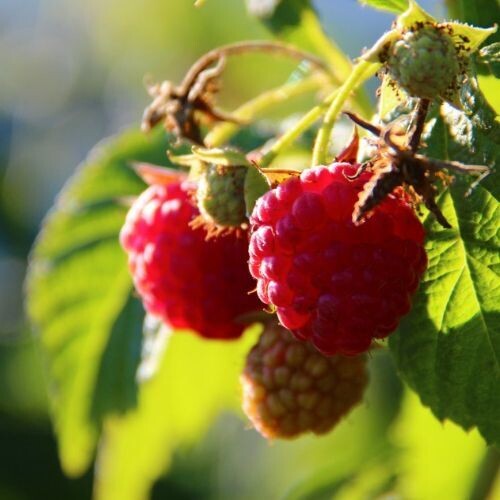
RASPBERRY LEAF for Horses (Rubus idaeus) | Mare's Season Support
Does your mare seem to feel her seasons physically?
Raspberry Leaf is one of the individual herbs we’d consider where the physical side of the mare’s cycle is the main priority.
Traditionally valued as a uterine tonic, its naturally astringent character supports normal pelvic and uterine muscle tone while providing gentle nutritional support throughout the cycle.
If seasonal mood, irritability or behavioural change is the bigger picture, MellowMare or Agnus Castus may be a better place to begin.
Think of Raspberry Leaf as support for the body of the cycle. Because sometimes it isn’t her attitude speaking - it’s her middle.
*Please note this is a nutritional, functional horse food supplement and not veterinary medicine.
For more on this, see Dr Kellon's Horse Sense - Nutrition is not 'Alternative' Therapy
.
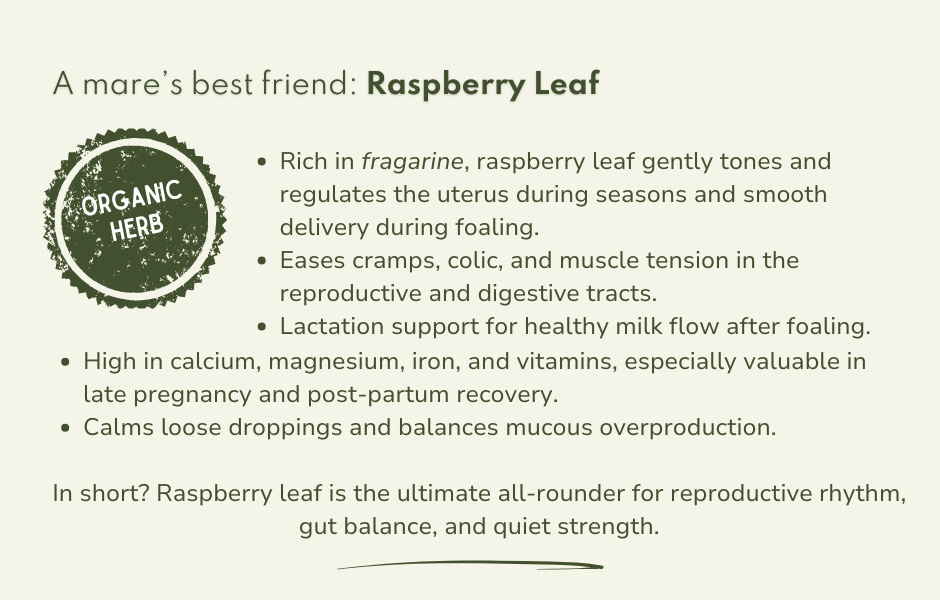
Find Raspberry Leaf in the EquiNatural range
It probably won’t come as any surprise that we blend raspberry leaf into our MellowMare, natural organic hormone harmony for calmer, happier mares.
Overview - A traditional mare herb with a very physical way of working
Raspberry Leaf has followed women and female animals through reproductive life for generations.
Its best-known traditional role is as a uterine tonic- a phrase which can sound as though the herb simply makes the uterus contract more strongly. The real story is rather more nuanced.
The uterus is made largely from smooth muscle. Across the reproductive cycle, this tissue must respond, relax and contract in a coordinated way. Traditional herbalists used Raspberry Leaf to support this natural muscular tone and responsiveness, particularly around menstruation, late pregnancy and recovery after birth.
Modern studies have found that Raspberry Leaf preparations can influence uterine smooth muscle, although the effect has not always been the same. Some extracts stimulated contraction, others relaxed the tissue, and the response varied with the preparation, concentration and reproductive stage being studied.
That may sound inconveniently untidy - but living systems usually are.
Raspberry Leaf doesn't just barge in and tell the uterus what to do. Its traditional reputation is much more about supporting normal tissue tone and responsiveness – although exactly how that translates into the living mare is still something science has to unravel.
More than the famous “ fragarine ”
Raspberry Leaf’s reproductive reputation is often attributed to a compound called fragarine , traditionally associated with effects on pelvic and uterine muscle.
But a leaf is rarely the work of one headline ingredient. Raspberry Leaf contains a much wider collection of naturally occurring constituents, including tannins, flavonoids and phenolic compounds, and research hasn’t established that any single one explains its traditional relationship with uterine tone and responsiveness.
Its tannins have a rather different role. They give Raspberry Leaf its distinctly astringent character - that gently drying, tissue-toning quality familiar to herbalists. This helps explain its traditional use beyond reproductive support, particularly where tissues or digestive contents are a little too loose - hence its long-standing association with occasional loose droppings.
So while fragarine tends to get the headlines, Raspberry Leaf is very much a whole-leaf story.
Where does it fit for the mare?
Raspberry Leaf is most at home where a mare appears to experience her cycle physically - perhaps becoming tense through her middle, sensitive around her flanks or less comfortable as her seasons change.
It isn’t a direct hormone regulator, and it won’t cover every expression of seasonal behaviour. When mood, reactivity or a much wider hormonal pattern dominates, a broader formula such as MellowMare or an endocrine herb such as Agnus Castus usually makes more sense.
But where the reproductive tissues themselves are asking for gentle support, Raspberry Leaf has a beautifully specific place.
A soft green leaf for a complicated female system - gently supporting the mare from the middle out.
Composition & feed guide💧Organic raspberry leaf tincture
Our human-grade, certified organic tinctures capture the plant's naturally occurring constituents in a concentrated, easy-to-feed liquid form.
- Rubus idaeus (Raspberry), Leaf
- Infused 1:3 25%
- Fresh Organic
- Feed Guide - 6ml/100kg bodyweight, daily in feed.
🌿Organic dried raspberry leaf
Grown, harvested and dried without the use of agri-chemicals, non-irradiated and GMO free - see our Quality page for Quality Management & Certification Documents.
- Rubus idaeus (Raspberry), Leaf
- Fairwild
- Origin Poland
- Feed Guide - 5g/100kg bodyweight per day, i.e. 25g for a 500kg horse.
Footnotes
- Laboratory tested for identification and compliance to the British and European Pharmacopoeia standards.
- Human grade.
- Please be aware that if you're purchasing our dried botanicals for human use, our dried range is cut to appropriate sizes for feeding to horses.
- ♻️ Eco Note: Our packaging is recyclable and refillable.
- 🧊 Storage Tip: Keep cool and dry.
Naturally occurring plant constituents
Tannins (gallotannins, ellagic acid), flavonoids (kaempferol, kaempferol glycosides, quercetin, quercetin glycosides, hyperoside), phenolic acids (caffeic acid, chlorogenic acid), terpenoids (terpinolene, 3-oxo-α-ionol, a-amyrin, β-amyrin, squalene, cycloartenol), alkaloids (fragarine), volatile oils, vitamins (C, B, E), and minerals (calcium, iron, phosphorus, potassium, magnesium, manganese, zinc).
" Energetics
" - how Raspberry Leaf works
If you want the science, 'energetic architecture' explains how a herb is designed to work within the body - not just what's in it, but the particular tissues and functions it has an affinity with.
Raspberry Leaf is a gently astringent uterine tonic, traditionally used to support tone and coordinated responsiveness within the pelvic and reproductive tissues.
Think of it as helping the mare’s middle feel supported and organised – without trying to take charge of her hormones.
How Raspberry Leaf works
- Supporting responsive muscle tone - The uterus is made largely from smooth muscle, which must relax and contract appropriately throughout the reproductive cycle. Raspberry Leaf has traditionally been used to support that natural responsiveness – encouraging tone without simply pushing the tissue towards either contraction or relaxation.
- Supporting tissues through its astringent character – Raspberry Leaf's tannins give it the gently drying, astringent quality traditionally valued where digestive contents are rather too loose. This is a different aspect of the herb from its reproductive reputation, but another reason herbalists have long valued the whole leaf.
- Providing gentle nutritional support - Raspberry Leaf also supplies flavonoids, vitamins and minerals traditionally valued during cyclical change and reproductive demand. This isn’t its main job, but it gives the mare some nourishment alongside the more targeted tissue support.
Big picture
Raspberry Leaf isn’t primarily a hormone-balancing herb. Its affinity is with the physical machinery of the cycle – supporting tone, responsiveness and coordination through the mare’s middle.
Not a hormone switch, not a quick fix – just a traditional herb with a particular affinity for the physical side of the mare's cycle.
Clinical considerations
Advisories
- Raspberry Leaf is traditionally used for reproductive and digestive support, but clinical evidence in horses remains limited.
- Introduce gradually and observe your mare's individual response.
- If your mare shows significant, persistent or new abdominal sensitivity, discomfort or behavioural changes, seek veterinary advice rather than assuming these are related to her cycle.
- Raspberry Leaf contains tannins. If your horse has a diagnosed digestive condition or is receiving medication, check with your vet before use.
Pregnancy and nursing
- Raspberry Leaf has a long history of traditional use around pregnancy and foaling, but its effects on uterine smooth muscle can vary, and its safety in pregnant or nursing mares has not been adequately established.
- Avoid use during pregnancy or nursing unless specifically advised by your vet.
Raspberry Leaf in history & tradition
Raspberry Leaf in History & Tradition
The little leaf that's been keeping women company for centuries
Some herbs become famous because they're dramatic. Raspberry Leaf became famous because it calmly found its way into some of life's biggest moments.
Long before anyone understood hormones, smooth muscle or reproductive physiology, traditional herbalists were gathering Raspberry Leaf for use around women's monthly cycles, pregnancy, childbirth and recovery.
It wasn't the glamorous part of the raspberry plant. The berries were the obvious attraction, but the leaves developed a reputation of their own.
And what a reputation for such an ordinary-looking leaf.
A little Greek mythology along the way
Even the raspberry's botanical name comes with a story.
Greek mythology links the raspberry with Mount Ida and the infant Zeus. In one version of the tale, a nymph named Ida stains the berries red with her blood while gathering them for the baby god.
Hence Rubus idaeus – the raspberry associated with Mount Ida.
Whether the story explains the name quite as well as the storytellers would have us believe is another matter. But it's a lovely reminder of how deeply plants became woven into human culture, long before anyone thought to examine their chemistry.
What the old herbalists noticed
Across European herbal traditions, Raspberry Leaf became particularly associated with women's reproductive health.
Herbalists described it as a uterine tonic – one of those wonderfully old-fashioned terms that sounds straightforward until you start asking what it actually means.
They also valued its astringent character, using the leaf in preparations for digestive complaints and other situations where a gently tightening effect on tissues was considered useful.
And this is where the story gets interesting. Modern research has explored Raspberry Leaf's effects on uterine smooth muscle, but the findings haven't produced one tidy answer. Different preparations have shown different effects, and we still don't fully understand how those observations translate into use in a living animal.
So the traditional reputation remains interesting, but it isn't the same thing as a proven clinical effect.
Which gives us something else to be curious about!
From women's herb to mare's herb
It's easy to see why a plant with such a long reproductive history eventually found its way into traditional approaches to mare care.
But there's an important distinction. Raspberry Leaf isn't a hormone switch, and not every mare who's grumpy during her seasons is experiencing reproductive discomfort.
Its particular place in our herbal cupboard is much narrower: a traditional herb we'd consider where the physical side of the mare's cycle seems to be the main concern. And even then, the mare herself has the final say.
So perhaps Raspberry Leaf's real charm is that it has never needed to be the shoutiest herb in the cupboard. Just a humble green leaf, with a bit of a colourful history.
Not bad for the bit of the raspberry plant that doesn't even come with the jam. 😉
Raspberry Leaf FAQs
How do I know if Raspberry Leaf is right for my mare?
The biggest clue is usually that your mare seems to feel her seasons physically.
We're talking sensitive around her flanks, a little tense through her middle, reluctant to be groomed around her belly, or simply less comfortable at certain points in her cycle.
With it having a long traditional reputation as a uterine tonic, supporting normal muscle tone and responsiveness within the reproductive tissues, if the physical side of her cycle seems to be the main issue, this is one of the individual herbs we'd consider, because it isn't always her attitude speaking - it's her middle. 😉
What's the difference between Raspberry Leaf and MellowMare?
Think physical comfort versus the wider seasonal picture.
Raspberry Leaf is our more specific choice where a mare seems physically uncomfortable during her cycle. Its traditional affinity is with uterine and pelvic tissue tone rather than directly regulating hormones.
MellowMare is our broader herbal formula for mares whose seasons seem to affect their mood, behaviour, sensitivity or general ability to cope.
So if your mare is uncomfortable through her middle, we'd think adding Raspberry Leaf.
If she's becoming unusually reactive, irritable, unsettled or difficult to manage around her seasons, that's MellowMare.
And sometimes both pictures overlap – because mares, bless them, don't always read the handbook.
Can Raspberry Leaf help a mare who's sensitive around her belly or flanks?
It's certainly one of the herbs we'd consider where that sensitivity appears to follow her seasons.
The uterus is made largely from smooth muscle, which naturally contracts and relaxes throughout the reproductive cycle. Raspberry Leaf has traditionally been valued for supporting normal tone and coordinated responsiveness within those tissues.
But if your mare seems particularly crampy or tense through her middle, we'd also consider Cramp Bark , traditionally used for its antispasmodic properties and support for smooth-muscle relaxation.
Think of Raspberry Leaf as supporting the tone of the reproductive tissues, while Cramp Bark has a more specific traditional affinity with spasmodic tension.
But here's the important bit: not every sensitive belly is a hormonal belly. Digestive discomfort, back pain, saddle fit, ovarian problems and other physical issues can produce similar reactions. So if the sensitivity is significant, new or persistent, we'd want a veterinary assessment rather than simply assuming she's being hormonal.
Lest we forget, mares are very good at trying to tell us something. Our job is to work out what.
How quickly should I expect to notice a difference with Raspberry Leaf?
Good question. And because we're looking at a cyclical pattern, we'd suggest observing your mare across a couple of seasons rather than judging everything from one particular day.
Notice whether she's moving comfortably, accepting grooming around her middle and behaving more like her usual self as her cycle progresses.
And if nothing changes, that's useful information too as it may simply mean Raspberry Leaf isn't addressing the underlying issue.
Can I feed Raspberry Leaf to a pregnant mare?
This is one situation where we'd be particularly careful.
Raspberry Leaf has a long history of traditional use around pregnancy and foaling, but its effects on uterine smooth muscle are complex, and we don't have sufficient equine clinical evidence to establish its safety throughout pregnancy.
We'd therefore avoid using it during early pregnancy and only consider it later in gestation under veterinary guidance.
The same caution applies to nursing mares and those recovering from reproductive complications.
It's a lovely traditional herb, but pregnancy is definitely not the time for experimenting with the feed bucket!
© EquiNatural 2026. All content is original work protected under copyright, and may not be re-published, duplicated, or rewritten for commercial use without permission.
