VALERIAN for Horses (Valeriana officinalis) | Deeper Calm for Nervous Horses 🍂OCTOBER SALE - 20%-OFF - USE CODE RESET20

Tense, restless, and seemingly unable to switch off?
Whether it's the farrier, the dentist ,or simply a horse that struggles to switch off, Valerian is the herb we reach for when everything feels just a little too much, and your horse needs deeper calming support.
Its traditional affinity with both the nervous system and the muscles makes it perfect for the horse who doesn’t simply feel worried; they hold that worry through their whole body.
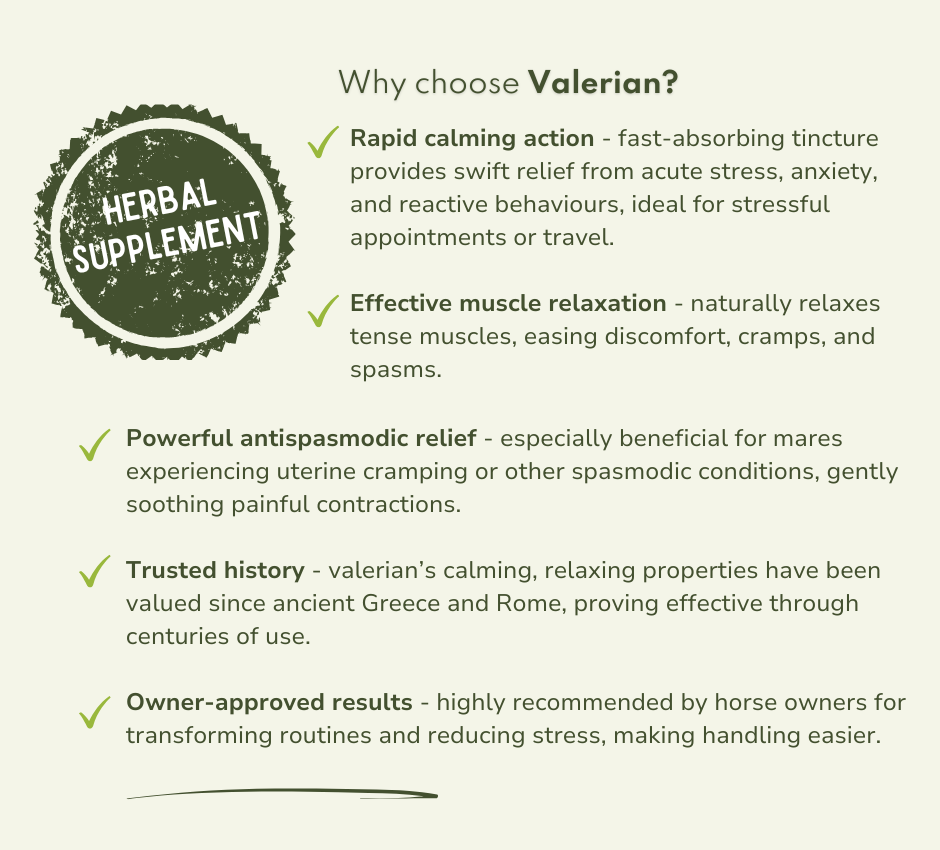
" I cannot recommend this enough for mares with severe cramping. Valerian has transformed our routine and eased so much discomfort." Helen B.
V alerian can be fed when this deeper nervine action is the priority, or used within a wider support plan where prolonged stress, discomfort or digestive tension might also need attention.
It does have one tiny drawback though: the root smells as though something has died behind your feed bin. But thankfully, its calming reputation is considerably lovelier than its perfume.
Important : Valerian is prohibited for competition use under many equestrian rules. Always check the current rules of your governing body and allow a suitable withdrawal period before competing.
*Please note this is a nutritional, functional horse food supplement and not veterinary medicine. For more on this see Dr Kellon's Horse Sense - Nutrition is not 'Alternative' Therapy .
Overview - turning down the nervous-system volume
The jaw's tight, the muscles stay braced, every sound triggers an immediate ear twitch... yet even when the worry has passed, the nervous system doesn’t quite get the message that it can stand down.
This is Valerian territory.
Valerian has been valued for centuries as a powerful nervine - a herb traditionally used to support an overactive or unsettled nervous system. Its particular benefit lies in the relationship between both nervous and physical tension (tense muscles), helping the horse soften through both.
Turning down the nervous-system volume
The nervous system relies upon a careful balance between signals that create activity and signals that slow things down, and one of it- principal calming messengers is GABA — gamma-aminobutyric acid. Think of GABA as part of the nervous system’s braking mechanism, helping prevent every signal from being treated as urgent.
Compounds within Valerian root, particularly valerenic acids , have been studied for their interaction with GABA-A receptors. Rather than simply “increasing GABA”, as is often claimed, Valerian appears to support the way this calming signal is received and used within the nervous system.
The practical effect is really simple - help the nervous system turn the volume down enough for the horse to respond, release and recover.
When worry moves into the body
Nervous tension rarely stays inside the brain, and it doesn't take long before it can show up as tight or spasming muscles, abdominal tension, cramping, restlessness... How manyt imes have we seen a horse who's still physically braced well after the original trigger has disappeared?
Valerian’s traditional antispasmodic character is one reason herbalists have used it where both mental and muscular tension appear together. This also explains its long association with digestive or uterine cramping - and why Helen noticed such a difference in her mare:
“I cannot recommend this enough for mares with severe cramping. Valerian has transformed our routine and eased so much discomfort.” Helen B.
Even better, while it's known as having a "mild sedative" effect, it's not a full-on knockout. It's more of a botanical nudge towards the state the body is already trying to reach: softer muscles, calmer trigger signals, and moving towards letting the moment pass.
Why choose Valerian rather than a calming blend?
Choose Valerian when its particular combination of deeper nervous-system support and physical release is the main priority - hence why it's renowned for mares who struggle with their seasons.
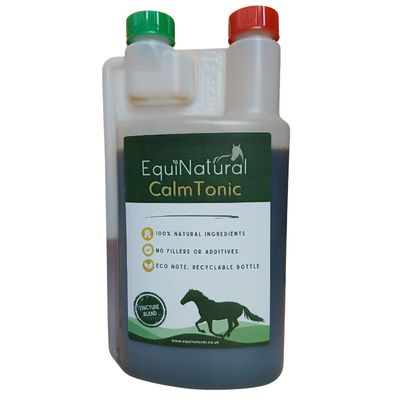
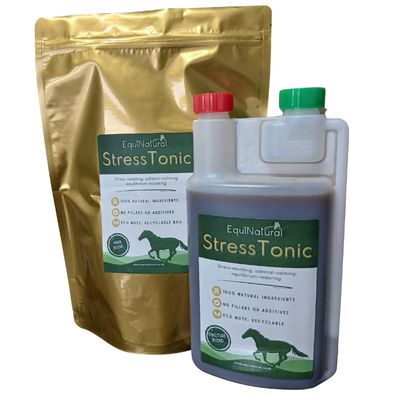
For a broader response to more predictable situations such as travelling, clipping, or the farrier, our CalmTonic may provide more rounded support. Or where the horse has been living under prolonged stress and no longer recovers properly between challenges, StressTonic can be a better fit.
In short, valerian can help our horse find the brake pedal - but we should still ask why they’ve had their hoof on the accelerator.
How Valerian fits into your horse's plan
Valerian is ideal for when your horse doesn't just become anxious or unsettled – it's for when they're also holding tension through their whole body.
Choose Valerian if your horse:
✔ Struggles to relax even after the trigger has passed
✔ Becomes physically tense or braced alongside nervousness or anxiety
✔ Shows muscular tightness, restlessness or spasming associated with tension
✔ Finds particular situations overwhelming and takes longer than expected to settle afterwards
✔ Is a mare whose seasons bring noticeable physical tension or cramping
✔ Needs deeper nervine support rather than a broader, everyday calming blend
In short: if your horse's nervous system seems to have forgotten where the off-switch is – and their muscles have joined in – Valerian is an ideal go-to.
Supporting the wider picture
Valerian has a particular job to calm the nervous system and release physical tension, but it won't necessarily address what's keeping your horse tense in the first place.
- CalmTonic – where your horse is struggling with a specific, predictable situation such as travelling, clipping, or the vet/farrier. It's our valerian-free support, particularly useful where competition rules matter.
- StressTonic – where tension has become part of everyday life. If your horse is persistently vigilant, reactive, tired-but-wired, or unable to properly switch off, we'd look at supporting the wider stress response.
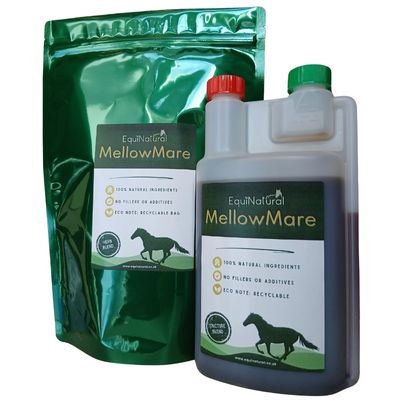
- MellowMare – where the pattern is clearly linked to a mare's seasons, particularly if behavioural changes accompany the physical tension. MellowMare is the more targeted choice for ongoing cycle-related support, and for some owners with Valerian alongside.
Foundation support
Supporting your horse's baseline nutrition with a forage-based mineral blend such as EquiVita or VitaComplete helps provide the nutritional foundations that healthy nervous-system function and normal muscle activity depend upon.
*If you're not already feeding a mineral balancer, try one of our 1kg trial bags.
In summary
Valerian is a really useful herb to have on the shelf, sadly with a rather unfortunate perfume, but with a very particular place in the support plan for when nervous and physical tension are both on the scene.
And remember that Valerian is prohibited under many competition rules, so always check the relevant regulations before use.
Composition & feed guide
💧Organic valerian tincture
Our human-grade, certified organic tinctures capture the plant's naturally occurring constituents in a concentrated, easy-to-feed liquid form.
- Valeriana officinalis (Valerian), Root
- Decocted 1:3 35%
- Organic Cultivated
- Feed Guide - 6ml/100kg bodyweight, daily in feed.
Naturally occurring plant constituents
Alkaloids, gamma aminobutyric acid, irioids (valepotriates), volatile oils, valeric acid, sesquiterpenoids, v alerenic acids, sesquiterpenes, valepotriates, l inarin .
Energetics
- how Valerian works
If you want the science, ' energetic architecture ' explains how a herb is designed to work within the body - not just what's in it, but the particular tissues and functions it has an affinity with.
Valerian is a deeply relaxing nervine with a particular affinity for the point where nervous tension becomes physical tension. Think quieter signals, softer muscles and a body that can finally stand down.
How Valerian works
- Strengthening the nervous system’s brake pedal - Valerenic acids within the root interact with GABA-A receptors, one of the nervous system’s principal calming pathways, helping to calm overreaction to everything.
- Releasing tension held in the body - its antispasmodic action supports muscles that remain tight, braced, or prone to spasm. This makes it so beneficial when nervousness is felt physically – through the muscles, digestive tract or uterine tissue.
- Interrupting the tension loop - A worried nervous system tightens the body; a tight or uncomfortable body sends more alarm signals back to the brain. Valerian supports the two-way communications, helping the horse soften rather than simply suppressing the outward behaviour.
Big picture
Valerian strength lies in helping nervous tension and physical tension release together.
Quieter signals, softer muscles – then finally able to let go.
Clinical considerations
- Pregnant or nursing mares - always seek veterinary advice before feeding.
- Valerian is a banned substance - not to be used when competing under rules.
Valerian in history & tradition
The root that helped the world unwind
Some herbs have a beautiful fragrance, others have beautiful flowers. Valerian, bless it, has never relied on either to make friends.
In fact, if you've ever opened a bag of dried Valerian root, you'll know exactly what I mean. It's one of those smells that makes you immediately wonder whether something has gone terribly wrong in the herb cupboard. (Cats love it though!)
And yet, for more than two thousand years, people have been willing to overlook that rather unfortunate perfume.
Why? Because it's just so good at what it does - helping the mind and body to properly let go, as in genuinely relax, right down to the muscles that have been holding onto the day's tensions.
From ancient Greece to the medieval herb garden
The ancient Greeks were already familiar with Valerian, and physicians including Dioscorides and Galen described its medicinal uses.
Its botanical name is traditionally linked to the Latin valere , meaning to be strong or well. Which is rather lovely when you think about it, because although we tend to associate Valerian with calming, traditional herbalists often viewed it as something rather broader - a restorative herb for people whose nervous systems had become unsettled or exhausted.
Over the centuries it found its way into monastery gardens, household remedies, and herbal dispensaries throughout Europe. People turned to it when sleep wouldn't come (still do) or when worry seemed impossible to shake, or when nervous tension settled into the stomach, or when muscles tensed up.
One familiar pattern - the body couldn't quite stand down.
And then there were the rats...
A little bit of Valerian history. Apparently, humans aren't the only creatures fascinated by this peculiar-smelling root.
The aforementioned cats become very keen on it, and rodents have also been attracted to its scent.
So enthusiastic, in fact, that folklore has linked Valerian to the Pied Piper of Hamelin, suggesting that his mysterious ability to lure rats away might have involved a bit of botanical assistance rather than musical talent.
Whether there's any truth in that is another matter entirely... But I love the thought that one of herbal medicine's most respected calming roots might also have been responsible for a medieval rodent evacuation.
You couldn't make it up. Well... someone might have.
What herbalists noticed before neuroscience arrived
One of the things I find really interesting about how traditional herbalists thought about Valerian is that they didn't always separate emotional tension from the physical.
They noticed that worried people often had tense bodies, or that poor sleep accompanied nervous exhaustion. Or that digestive cramping often accompanied emotional distress, or that calming the nervous system sometimes seemed to help the body soften as well.
Today, researchers are particularly interested in Valerian's interaction with GABA signalling - one of the nervous system's natural calming mechanisms. But those early herbalists didn't need to understand neurotransmitters to recognise the relationship.
They simply noticed that the mind and muscles often seemed to relax together, which was a great observation because sometimes the body carries tension long after the original worry has disappeared.
Why Valerian still matters for horses today
It's easy to judge whether a horse is calm by what we can see. Are they standing quietly, stopped fidgeting, okay for the farrier?
But outward stillness doesn't necessarily mean the nervous system has relaxed - some horses carry their worry physically, and that's where we have that feeling that they're holding themselves together, rather than genuinely feeling comfortable.
And that's where Valerian is so useful, because it's so beneficial when both nervous and muscular tension appear together.
Of course, we still need to ask why the horse is tense in the first place. Pain, discomfort, or fear, won't disappear simply because we've added a herb to the feed bowl.
But maybe that's why Valerian has remained so respected for so long. It may be stinky, but there's a world of difference between a horse who's standing still and a horse who's genuinely able to relax.
Valerian FAQs
How do I know if Valerian is right for my horse?
The biggest clue is often that your horse doesn't simply become worried – they hold that worry through their whole body.
That's where we'd consider Valerian. Traditionally valued as a deeply relaxing nervine, with a particular affinity for the relationship between nervous tension and physical tension.
Of course, we'd still want to understand why they're tense. Pain, digestive discomfort, fear or unsuitable management can all keep a horse on high alert.
Will Valerian sedate my horse or make them sleepy?
Valerian does have recognised sedative properties, so reduced alertness is possible.
But the intention behind using it isn't to produce a horse who stands quietly because they're too sleepy to respond. We're looking for effective support where nervous tension and physical tension go hand in hand.
What's the difference between Valerian, CalmTonic and StressTonic?
They each have their own place.
- Valerian is the individual herb we'd consider where deeper nervous tension and physical tightness seem closely connected.
- CalmTonic is our broader, valerian-free formula for specific, predictable situations – travelling, clipping, the farrier or similar when your horse needs a little extra help coping.
- StressTonic is the one we'd look towards when chronic stress has become part of everyday life.
So it's less about which is the strongest calmer and more about understanding the pattern.
Can Valerian help mares who become tense or crampy during their seasons?
This is one of Valerian's interesting uses.
Herbalists have long valued it for its antispasmodic character, particularly where nervous tension and smooth-muscle tension appear together.
So if your mare becomes noticeably tense through her middle around her seasons, Valerian could be one of the herbs we'd consider for short-term support, but we'd also look at the wider picture.
Cramp Bark has a more specific traditional relationship with spasmodic muscular tension, while Raspberry Leaf is traditionally used to support normal uterine and pelvic tissue tone.
And where seasonal mood or behavioural changes are the bigger concern, MellowMare may be a better starting point.
Can I use Valerian before travelling, clipping or a farrier visit?
Potentially, although we'd usually consider CalmTonic first for those predictable, short-term situations.
Valerian has a more specific traditional role where a horse becomes deeply tense, physically braced or struggles to relax afterwards.
But whichever herbal support you choose, it doesn't replace helping your horse feel safe and confident with the task itself.
And because Valerian can cause drowsiness, we'd be cautious about using it before situations where balance, coordination and alertness are particularly important.
The herbs may support the horse, but they won't teach them how to load!
Can I feed Valerian to a competition horse?
Not when competing under rules that prohibit it.
Valerian contains naturally occurring compounds with calming and sedative activity, and as a result it's prohibited under FEI rules and many other equestrian competition regulations.
If you're competing, always check the current prohibited-substances rules for your governing body before feeding Valerian.
Withdrawal periods can also vary, and there's no universally reliable clearance time for every horse and preparation.
For horses needing situational support where competition rules matter, we'd usually look towards our valerian-free CalmTonic instead.
© EquiNatural 2026. All content is original work protected under copyright, and may not be re-published, duplicated, or rewritten for commercial use without permission.