
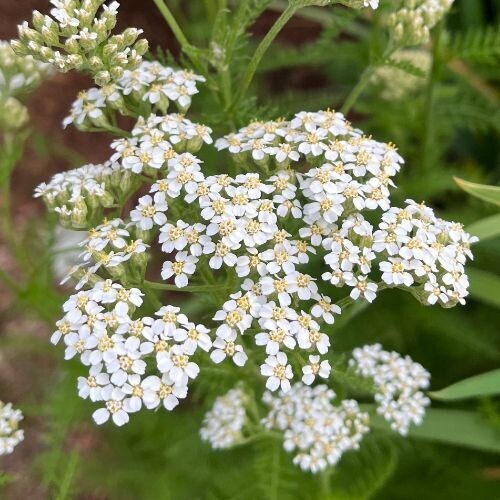
YARROW for Horses (Achillea millefolium) | Seasonal Comfort & Respiratory Support
Yarrow Herb for Horses
Most people know Yarrow as a traditional wound herb. Around here, we reach for it for something rather different... helping horses respond more comfortably to the changing world around them.
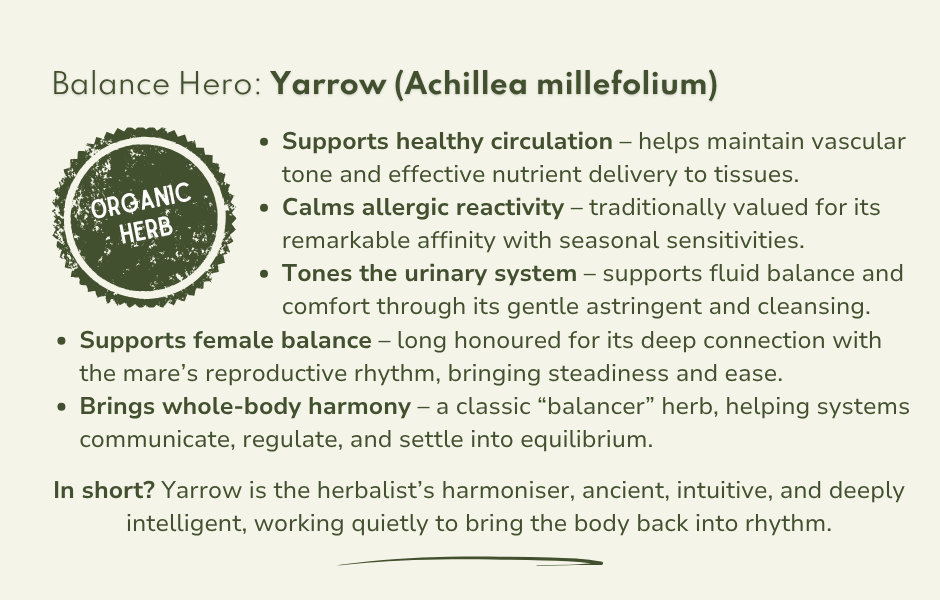
Yarrow is one of the most versatile "balancing" botanicals we know - a wild-growing powerhouse with an ancient reputation for supporting healthy skin, circulation, seasonal challenges, and the female reproductive system.
Whether sipped as a tea, applied as a poultice, or fed freshly picked, yarrow is one of those herbs herbalists never seem to be without.
*Please note this is a nutritional, functional horse food supplement and not veterinary medicine. See Dr Kellon's Horse Sense - Nutrition is not 'Alternative' Therapy .
Find Yarrow in the EquiNatural range
We blend yarrow into many of our supplements including BreathePlus , GutBitters , MellowMare , and PollenTonic .
Composition & Feed Guide
💧Organic Yarrow Herb Tincture
Our human-grade, certified organic tinctures give you a ready-to-absorb potent source of phytonutrients at the highest-strength available, for immediate absorption straight into the bloodstream and to the body’s cells.
- Achillea millefolium (Yarrow)
- Flowering tops
- Distilled/Infused 1:3 35%
- Organic Grown
~ Feed Guide - yarrow tincture for horses
- 6ml/100kg bodyweight, daily in feed.
- Our tinctures come in a heat-sealed, twin-neck, child-resistant HDPE plastic dosing bottle, complete with dosing chamber. ♻️ HDPE is recyclable and low-impact - aligned with our sustainability ethos.
🌿Organic Dried Yarrow Herb
Grown, harvested and dried without the use of agri-chemicals, non-irradiated and GMO free - see our Quality page for Quality Management & Certification Documents.
- Achillea millefolium (Yarrow) , Organic Cultivated *, Origin UK
- Flowering Tops
- Organic Cultivated*
- Origin UK
* Grown especially for us organically and biodynamically by Organic Herb Trading Co. https://www.biodynamics.com/what-is-biodynamics
~ Feed Guide - dried yarrow herb for horses
- 5g/100kg bodyweight per day, i.e. 25g for a 500kg horse.
- Want a scoop? You can add a scoop to your basket during checkout.
- ♻️Supplied in a 100% fully recylable, resealable, food-grade foil pouch for freshness.
Functional Nutritional Value
Constituents: Volatile oil (e.g., α- and β-pinene, borneol, bornyl acetate, camphor, alpha-caryophyllene, 1,8 cineole [Hoffmann, 2003], thujone [Wood, 2009]), sesquiterpene lactones (e.g., achillicin, achillifolin, achillin, millifin, millifolide), flavonoids (e.g., apigenin, isorhamnetin, luteolin, rutin), tannins, phenolic acids (e.g., caffeic acid, salicylic acid), alkaloids (e.g., achiceine, achillein, moschatine, stachydrine, trigonelline), coumarins (Hoffmann, 2003), achilleic acid (aconitic acid), potassium, and calcium salts, vitamin C, bitters, and sterols.
Footnotes
- Laboratory tested for identification and compliance to the British and European Pharmacopoeia standards.
- Human grade.
- Please be aware that if you're purchasing our dried botanicals for human use, our dried range is cut to appropriate sizes for feeding to horses.
- ♻️ Eco Note: Our packaging is recyclable and refillable.
- 🧊 Storage Tip: Keep cool and dry.
Clinical Considerations
- Yarrow is not recommended during pregnancy due to its emmenagogue action.
- Its safety has not been established for use during nursing.
Yarrow in History & Tradition
It’s always difficult to know where to start with yarrow, for the simple reason that it’s so useful for so many different issues. Yarrow really requires an entire book for itself!
Yes it’s a common weed that grows freely in grassland, chalk land, roadsides – go on any walk or ramble and you’ll likely see yarrow. And yet it’s an incredible healing herb. Otherwise known as Achillea millefolium , it's not only antimicrobial, relieves pain and stops bleeding, but it’s most famous and most ancient use is as a wound healer.
Just like some herbs have one famous job, i.e. milk thistle is synonymous with the liver, and mullein belongs to the lungs, yarrow refuses to be put in just one box.
In fact, I sometimes think that's exactly why it doesn't receive the recognition it deserves - because wherever herbalists looked over the centuries, Yarrow seemed to turn up.
Supporting the skin, the circulation, digestion, the urinary system, women's reproductive health, seasonal wellbeing - even the body's response to wounds and injury.
It's almost as though the plant had an uncanny ability to notice where balance had been lost, and then helped restore it.
A companion for thousands of years
Yarrow's relationship with us humans stretches back astonishingly far. So far, in fact, that pollen from Yarrow has been discovered in a Neanderthal burial estimated to be around 50,000 years old.
Think about that for a moment - long before farming, long before written language, and long before recorded medicine - people were already gathering this remarkable little wildflower.
That alone tells us something.
The herb of Achilles
Of course, most people know Yarrow through the story of Achilles.
Legend tells us that his mother bathed him in Yarrow as an infant for protection, while later, during the Trojan War, Achilles supposedly used the herb to help care for wounded soldiers.
Whether every detail of the story is true almost doesn't matter. What matters is what it tells us about how highly Yarrow was regarded. The plant became so closely associated with healing that it eventually borrowed Achilles' name itself.
- Achillea millefolium.
Even today, every time we say its botanical name, we're quietly retelling that ancient story. I rather like that.
What herbalists kept noticing
One of the things I love about the yarrow story is how often completely different herbal traditions described the same plant in surprisingly similar ways. Not always with the same words, but with the same idea.
Some described it as a herb that moved stagnant blood, others as one that cooled excessive heat. Some reached for it when tissues needed soothing, others when circulation needed encouraging.
Different languages, different medical systems, yet the same underlying observation appeared again and again - that yarrow seemed remarkably good at helping the body find its own equilibrium.
Long before anyone understood the chemistry inside the plant, herbalists had already recognised its gift for restoring balance.
Why Yarrow still deserves our attention
Something I've noticed over the years is that the herbs that quietly support regulation often don't receive the same excitement as the herbs with one dramatic headline job.
And yet, regulation is exactly what healthy bodies spend every second of every day trying to achieve. Perhaps that's why Yarrow appears throughout so many of our formulations.
Not because we're asking it to perform one single task, but because we're asking it to support the body's remarkable ability to adapt, regulate, and maintain harmony across multiple systems.
For me, that's what makes Yarrow so special. Not simply that it's one of history's great wound herbs but that, for thousands of years, it's been recognised as something much bigger.
Sometimes the greatest healers aren't the herbs that shout the loudest - they're the ones that help the whole body remember how to find its balance again.
In the words of Richard Lawrence Hool (1922), “ yarrow will not fail you ”. Perhaps it’s no coincidence that yarrow grows prolifically in fields and gardens and makes itself so readily available to us.
© EquiNatural 2026. All content is original work protected under copyright, and may not be re-published, duplicated, or rewritten for commercial use without permission.
