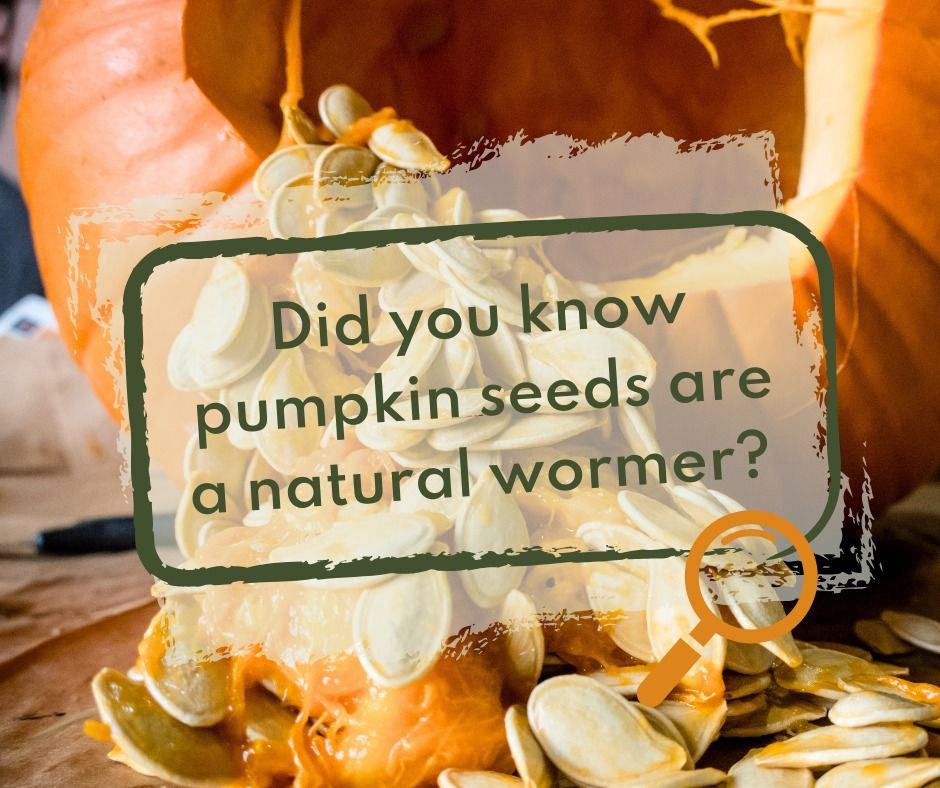
PUMPKIN SEEDS for Horses | Natural Tapeworm Support
Looking for natural support alongside your horse’s tapeworm-testing programme?
Pumpkin Seeds have a long history of traditional use where intestinal parasites - particularly tapeworms - are part of the picture.
Much of that reputation centres around cucurbitin , a naturally occurring amino acid found within the seed. This has made ground Pumpkin Seeds a popular wholefood addition for owners looking to support the intestinal environment as part of a test-led parasite programme.
They’re nutritious little things too, naturally providing protein, oils and minerals alongside their traditional role.
Feed them for their particular connection with tapeworm support - but keep testing firmly in charge. Even a seed with centuries of history behind it doesn’t get to overrule the laboratory.
*Pumpkin Seeds provide nutritional support and do not replace tapeworm testing or veterinary-prescribed treatment where required. P lease note this is a nutritional, functional food supplement and not veterinary medicine. For more on this see Dr Kellon's article - Nutrition is not 'Alternative' Therapy .
Overview - an ordinary-looking seed with an extraordinary history
What gave Pumpkin Seeds their rather wormy reputation?
Pumpkin Seeds look like a perfectly ordinary food - until you discover that people have been using them in traditional parasite-support programmes for centuries.
Their reputation stretches through human and veterinary herbal practice, with Pumpkin Seeds traditionally prepared and fed where intestinal worms, particularly tapeworms, were suspected.
At the centre of the story is cucurbitin .
This unusual, naturally occurring amino acid is found within the seed and has long been associated with Pumpkin Seeds’ traditional anthelmintic use. Laboratory research has identified activity from pumpkin-seed preparations against certain intestinal parasites, while studies in several animal species have produced interesting but variable results.
However, we don’t yet have good clinical evidence showing that feeding Pumpkin Seeds at nutritional levels will reliably clear tapeworms from horses. That distinction matters.
Support the horse - then test the horse
We see Pumpkin Seeds as a nourishing addition to a test-led parasite programme, rather than an alternative to it.
Modern saliva or blood testing helps establish whether tapeworm exposure is actually present. If treatment is needed, an appropriate veterinary wormer provides the predictable action required. Pumpkin Seeds can sit alongside that sensible approach as traditional nutritional support for the intestinal environment.
And unlike a concentrated extract or isolated constituent, ground whole seeds bring their complete nutritional package with them - protein, fibre, natural oils and minerals including magnesium and zinc.
So while cucurbitin gave Pumpkin Seeds their wormy reputation, the whole seed offers a fair bit more besides.
A traditional little addition to the feed bowl, a useful place within responsible parasite management - and absolutely no excuse for the tapeworm test to take the day off.
Composition & feed guide
🌿Organic dried pumpkin seeds
Soil Association Certified organic dried seeds, ground. See our Quality page for Organic Certification Documents.
- Cucurbita pepo, Seeds
- Organic cultivated
- Origin Austria
- ~ Feed Guide - 5g/100kg bodyweight per day, i.e. 25g for a 500kg horse
- Recommended: Feed for at least 2-weeks before testing for tapes.
Footnotes
- Laboratory tested for identification and compliance to the British and European Pharmacopoeia standards.
- Human grade. We only sell human-grade pumpkin seeds, and not those packaged for planting, which are treated with insecticides, fungicides and powdered fertilisers.
- Please be aware that if you're purchasing our dried botanicals for human use, our dried range is cut to appropriate sizes for feeding to horses.
- ♻️ Eco Note: Our packaging is recyclable and refillable.
- 🧊 Storage Tip: Keep cool and dry.
Functional nutritional value
Constituents:
A 10g serving contains approximately: 3.02g Protein, Total fat 4.0g(Omega 6 2.07g / Omega 3 12mg), 0.6g Fibre, 59mg Magnesium, 0.78mg Zinc
"Energetics" - how Pumpkin Seeds work
When it comes to herbs and herbal formulations, you may have heard herbalists talk about energetics. It’s simply the way we describe how a herb or formula has been designed to support the body in a balanced and purposeful way. The science helps us understand why that structure works.
Pumpkin Seeds are unusual because they combine the nourishment of a whole food with a very particular traditional relationship with intestinal parasites.
Think of them as supporting the horse and the intestinal environment at the same time – gentle in character, but surprisingly specific in purpose.
How Pumpkin Seeds work
Much of Pumpkin Seeds’ traditional reputation centres around cucurbitin supporting the gut’s response to parasites. This unusual amino acid has attracted interest for its possible effects on parasite activity and attachment within the intestine, potentially helping the body’s normal clearance mechanisms do their job.
This remains a traditional and investigational action rather than a reliably proven equine treatment – which is why testing still leads the programme.
Nourishing the horse underneath
Pumpkin Seeds also provide natural oils, protein, fibre and minerals including magnesium and zinc. Unlike a concentrated plant extract, the whole seed supports the intestinal environment while contributing useful nutrition to the horse.
Big picture
Pumpkin Seeds nourish the horse, support the gut, and bring one very particular traditional connection with tapeworms – while the test remains firmly in charge.
Clinical considerations
Advisories
- Considered a safe, nutritious functional food source rich in zinc, magnesium, essential fatty acids, and protein.
- Widely used in both equine and human nutrition without contraindications.
- Non-toxic, non-allergenic (except in extremely rare individual sensitivities).
- No known issues for pregnant or nursing mares.
Cautions
- Store in cool, dry conditions as the natural oils can go rancid over time.
- Excessive intake (well above feed guidelines) could theoretically contribute to mild digestive looseness due to natural oil content.
Important
Pumpkin Seeds are nutritional support, not a substitute for tapeworm testing or veterinary-prescribed treatment where indicated.
Pumpkin seeds in history and tradition
The humble seed that made it into the medicine cabinet
Long before Pumpkin Seeds became the fashionable green topping scattered over salads, they had acquired a somewhat more specialised reputation.
Pumpkins originated in the Americas, where their seeds were valued as both a nutritious food and part of traditional plant practice. Among their many uses was support for clearing intestinal worms - knowledge later adopted by Western herbalists and physicians.
By the nineteenth century, Pumpkin Seeds had travelled well beyond the kitchen. Their reputation as a gentle traditional worm remedy became sufficiently established for them to be included in the United States Pharmacopoeia from 1863 until 1936.
That is quite a career for something we now mostly find beside the sunflower seeds.
Chinese herbal tradition
Pumpkin Seeds also became known in Chinese herbal practice as Nan Gua Zi , where they were traditionally used in preparations intended to expel intestinal parasites, particularly tapeworms.
Historical preparations often combined crushed raw Pumpkin Seeds with other herbs. One such pairing - Pumpkin Seed with areca nut - was later studied during the twentieth century in people with tapeworm infection.
We certainly wouldn’t reproduce those old formulations in the feedroom today, but they show that Pumpkin Seeds’ wormy reputation wasn’t a passing piece of countryside folklore. It appeared repeatedly across different healing traditions and eventually attracted formal medical interest.
Then science found cucurbitin
As plant chemistry advanced, researchers identified cucurbitin , an unusual amino acid naturally present in seeds of the Cucurbita family.
Cucurbitin became one proposed explanation for the seed’s historical association with intestinal parasites. Modern laboratory and animal studies have found interesting activity in Pumpkin Seed preparations, although the precise constituents involved - and how reliably they work in a living animal - remain under investigation.
And that brings their long story neatly into the modern feedroom.
Pumpkin Seeds have earned their place in traditional parasite support, but today we also have targeted testing to tell us whether tapeworm exposure is actually present.
The old herbalists gave us the clue, but modern diagnostics let us use it with considerably better spectacles on. 😉
Pumpkin Seeds FAQs
Can Pumpkin Seeds really help horses with tapeworms?
They have a fascinating history of being used for exactly that purpose.
Pumpkin Seeds contain cucurbitin
, an unusual naturally occurring amino acid associated with their traditional use against intestinal parasites, particularly tapeworms.
Laboratory research has found interesting activity in them, so we see them as traditional nutritional support alongside a responsible, test-led parasite programme.
Can I use Pumpkin Seeds instead of a chemical tapewormer?
Although Pumpkin Seeds have a long history of traditional parasite use, they haven't been shown to reliably eliminate equine tapeworm infections.
That's an important distinction because tapeworms can be associated with serious intestinal problems, including colic.
Our approach is straightforward: test first, treat appropriately when indicated, and use Pumpkin Seeds as additional nutritional support rather than a replacement for proven treatment.
Should I feed Pumpkin Seeds before my horse's tapeworm test?
You can include them as part of your horse's normal nutritional routine - for a 500kg horse, our usual feeding guide is 25g daily.
The important thing is to follow the testing schedule recommended by your vet and use the results to guide any necessary treatment.
Why do you use ground Pumpkin Seeds rather than whole seeds?
Put simply, they have a habit of coming back out the other end whole! We grind the seeds ourselves so you don't have to, making it easier to digest as well as exposing more of the seed's natural nutritional constituents.
This means you receive the product freshly ground - not having sat on a shelf for weeks on end, with your horse receiving the seed's wider nutritional package too, including protein, natural oils, fibre and minerals such as magnesium and zinc.
A lovely example of a traditional food having more than one reason to earn its place in the feed bowl.
Are Pumpkin Seeds useful for anything besides traditional parasite support?
Oh yes! They're nutritious little things in their own right, naturally providing protein, oils, fibre and several minerals.
This makes them a useful wholefood addition, although the relatively small quantities in our feeding guide mean they won't replace a properly balanced diet.
For us, their particular place in the range is their historical association with intestinal parasites, especially tapeworms.
But we love that they bring some everyday nourishment along for the ride.
Are Pumpkin Seeds safe to feed every day?
At our recommended feeding quantities, ground Pumpkin Seeds are generally a well-tolerated long-term wholefood addition for healthy horses.
As with any new feed, introduce them gradually and watch for individual digestive sensitivities.
Because seeds contain natural oils, storage matters too - make sure to keep them somewhere cool and dry.
© EquiNatural 2026 . All content is original work protected under copyright, and may not be re-published, duplicated, or rewritten for commercial use without permission.